Pizhichil Therapy in JVC | Ayurvedic Warm Oil Care
Pizhichil is a traditional Ayurvedic therapy in which warm medicated oil, or another liquid selected by the practitioner, is poured over the body in a slow, rhythmic stream, often alongside gentle massage. It has been practised for generations in Kerala’s Ayurvedic tradition and is sometimes known as Sarvanga Dhara or Kaya Seka. At Vedara Care Polyclinic in JVC, Dubai, Pizhichil is offered only after an Ayurvedic assessment, so the oil, temperature, treatment area and duration reflect your individual needs rather than a fixed routine. This page explains what the therapy involves and what to reasonably expect.
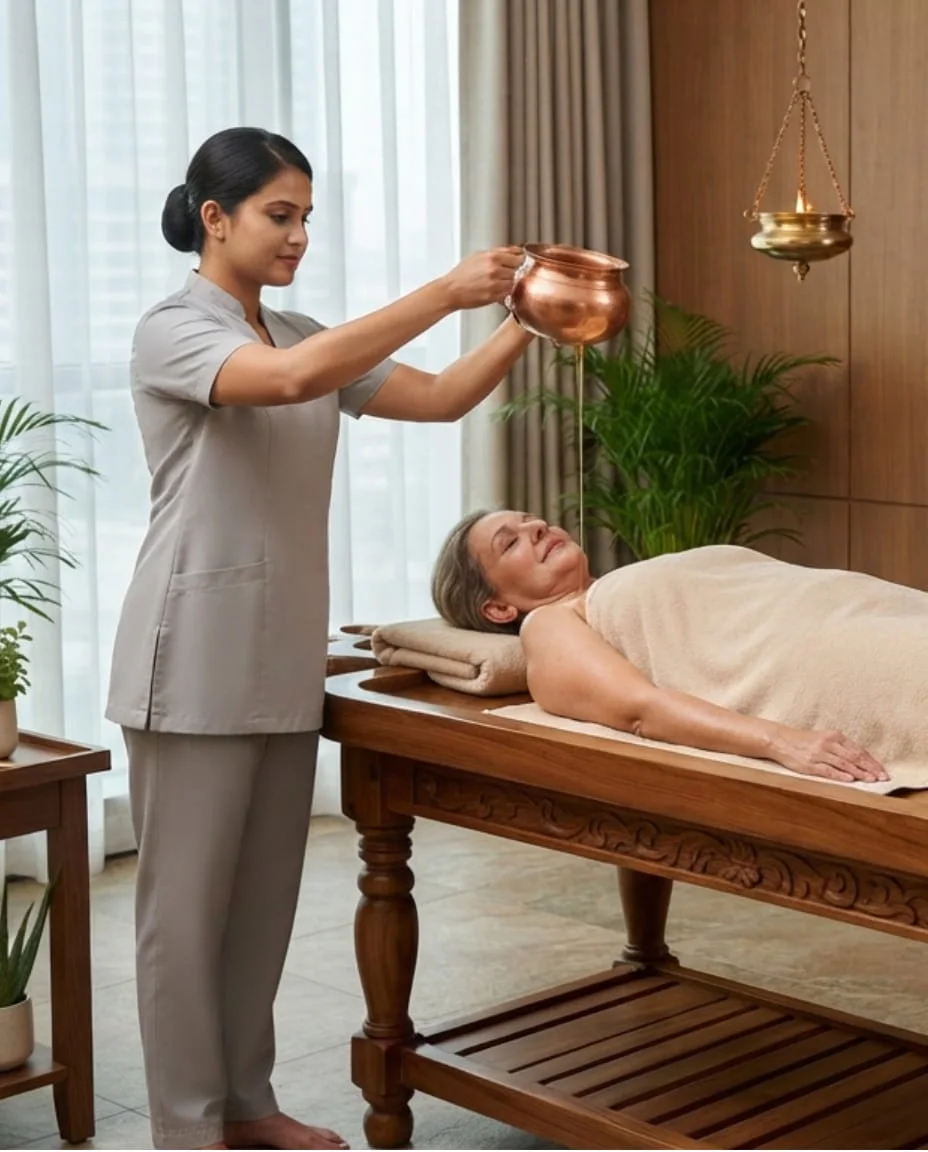
Warm Oil Bath Therapy
Pizhichil (Sarvanga Dhara / Kaya Seka) combines continuous warm medicated oil pouring with synchronized massage under practitioner supervision.
THE QUICK ANSWER
What is Pizhichil Therapy in JVC?
Pizhichil is a classical Ayurvedic therapy in which warm medicated oil, or a liquid preparation chosen by the practitioner, is poured over the body in a continuous, controlled stream while gentle massage may be performed alongside it. In traditional Ayurvedic thought, the therapy is associated with oleation (snehana), fomentation (swedana), musculoskeletal comfort and general rejuvenation-oriented care. These are traditional Ayurvedic concepts, and it is important to distinguish them from claims backed by established modern medical evidence — Pizhichil is not positioned here as a treatment with proven biomedical mechanisms. The specific oil or liquid used, the temperature maintained, the parts of the body treated, and the length of the session are not fixed. They depend entirely on the practitioner’s assessment of your constitution, current concerns and health history. Vedara Care’s Ayurveda service is delivered following individual Ayurvedic assessment by BAMS-qualified practitioners, and Pizhichil is approached the same way — as a therapy that is planned for the person, not applied as a standard protocol to everyone who walks in.
Reviewed by BAMS-Qualified Ayurveda Practitioners · Last updated August 2026
What Is Pizhichil?
The word Pizhichil comes from Malayalam and broadly describes the act of squeezing or pouring liquid in a controlled way.
The word Pizhichil comes from Malayalam and broadly describes the act of squeezing or pouring liquid in a controlled way. In classical Kerala Ayurveda, the term refers to a therapy in which warm medicated oil is repeatedly poured and gently massaged over the body by one or more therapists, working in a coordinated rhythm. Depending on the tradition and the practitioner, this same category of treatment may also be described as Sarvanga Dhara (“pouring over the whole body”) or Kaya Seka (“bathing the body”), and in some contexts the term Taila Dhara is used when oil specifically is the liquid poured.
What sets Pizhichil apart from an ordinary oil massage is the continuous or repeated stream of warm liquid that accompanies the massage strokes. A standard massage applies oil to the skin and works it in through pressure and movement. Pizhichil adds a further layer — liquid is poured over the body in a monitored, rhythmic manner, sometimes from a cloth or vessel, while the massage continues underneath it. It is this combination of pouring and kneading, sustained over a period of time, that traditional Ayurvedic texts associate with a distinct therapeutic experience compared to massage alone.
It is worth being upfront that Ayurvedic terminology is not perfectly standardised across every clinic or lineage. Some practitioners use Pizhichil and Sarvanga Dhara interchangeably, while others draw finer distinctions based on the liquid used, the technique, or the region the tradition originates from. This page describes Pizhichil in general terms; the exact protocol followed at any given visit is set by the treating practitioner.
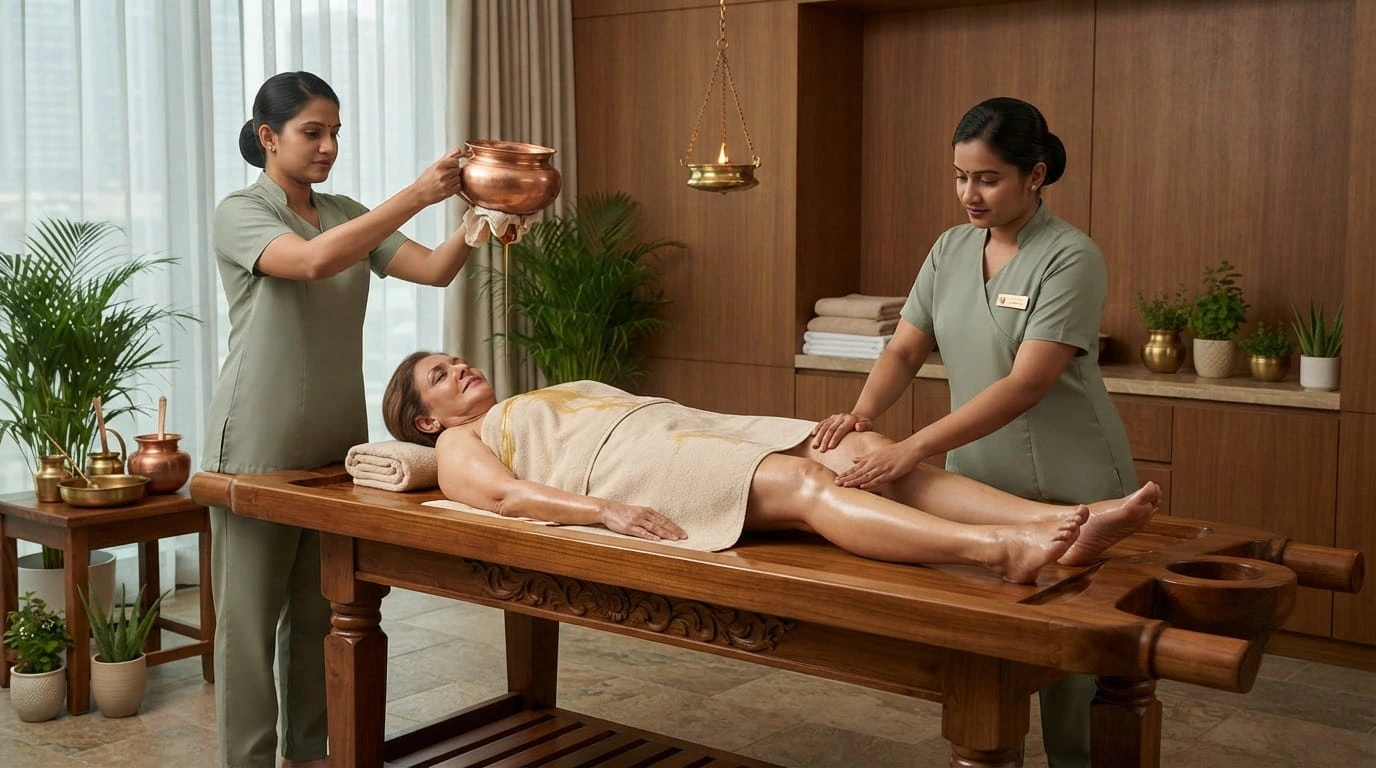
Pizhichil combines continuous warm liquid pouring with rhythmic massage.
TERMINOLOGY
Pizhichil vs Sarvanga Dhara: A Note on Terminology
Because these terms are often used loosely, it helps to separate them conceptually, even though there is real overlap in practice.
Pizhichil typically refers to warm, medicated oil poured over the body in a controlled stream, combined with massage.
Sarvanga Dhara is a broader umbrella term for pouring a prescribed liquid over the whole body — the liquid itself can vary by tradition and purpose, and oil-based Sarvanga Dhara often looks very similar to what is called Pizhichil.
The takeaway for a patient is simple: if you have seen both terms used online and are not sure whether they describe the same thing, the honest answer is that it depends on who is using the term. Ask your practitioner directly what they mean by it in the context of your treatment plan.
What Is Used During Pizhichil?
Pizhichil may involve medicated oils, herbal oil preparations, or other liquids selected specifically for the purpose of the session. There is no single, universal formula used across every clinic — the selection is a clinical decision made by the treating Ayurvedic practitioner, not a fixed recipe applied to every patient.
Factors that may influence what is chosen include the practitioner's Ayurvedic assessment of the patient, the individual's constitution, the objective of the treatment, the specific body area being addressed, the patient's skin sensitivity, and relevant medical history.
Because this decision is individualized, we do not describe a specific product or formulation as 'the' Pizhichil oil used at Vedara Care — that detail is something your practitioner will discuss with you directly during consultation.
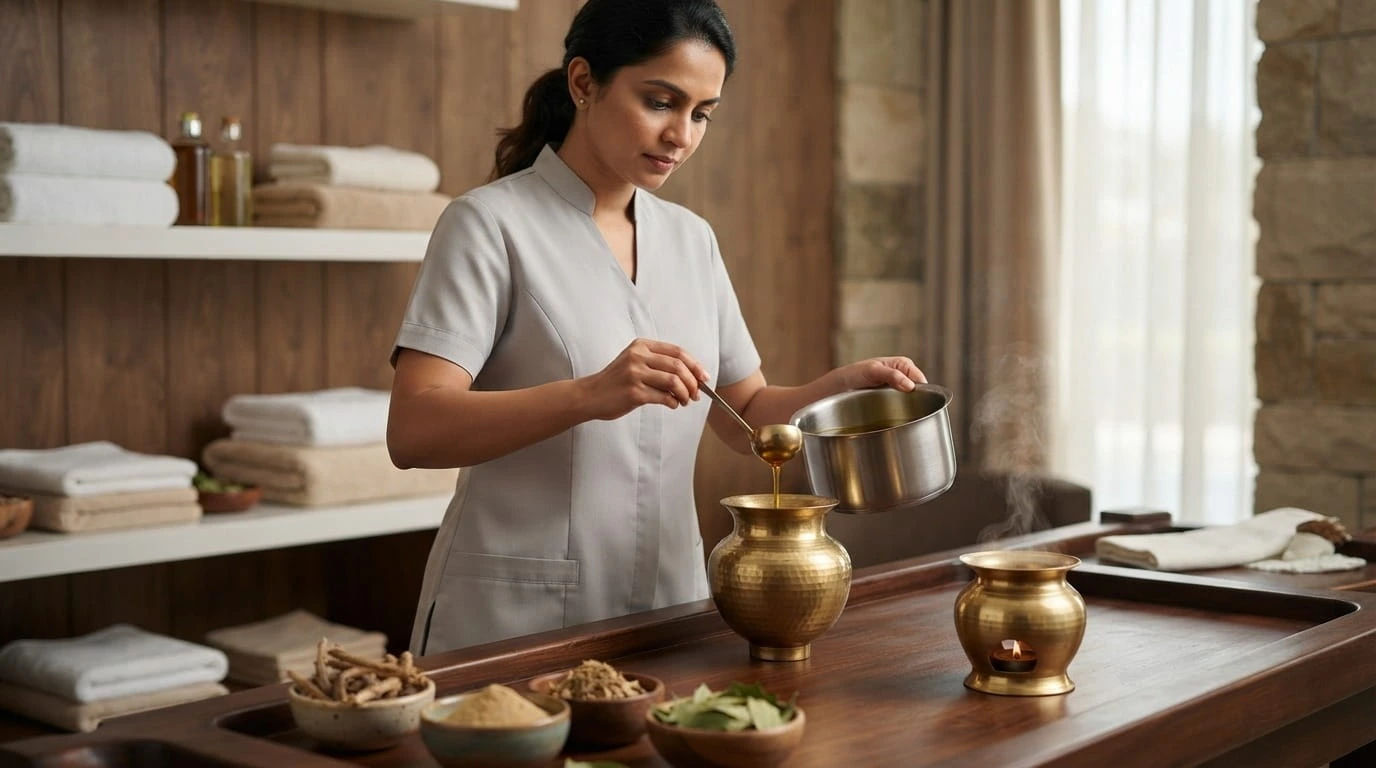
Oil selection and preparation follow individual Ayurvedic assessment.
TRADITIONAL RATIONALE
Why Is Warm Oil Used?
In classical Ayurveda, warmth applied through oil is linked to two related concepts: oleation (snehana), which refers to the traditional idea of the body being made supple and receptive through oil application, and fomentation (swedana), which refers to warmth encouraging a sense of looseness and comfort in the tissues. Together, these are traditionally described as contributing to relaxation and a softening sensation across the treated area.
It is important to state clearly: these are traditional Ayurvedic explanations rooted in a centuries-old system of thought, not claims validated by contemporary biomedical research. This page does not assert that warm oil “removes toxins” from the tissues in a medical sense, nor that it produces measurable physiological changes beyond the general relaxation response associated with warmth and touch. Patients are encouraged to understand Pizhichil within its traditional framework while also seeking appropriately evidenced medical care for diagnosed conditions.
What Does Pizhichil Feel Like?
Patients commonly describe a sensation of gentle, sustained warmth as the oil flows over the skin, paired with the rhythm of light massage strokes underneath. Many find the herbal aroma of the oil and the quiet, unhurried pace of the session contribute to an overall feeling of relaxation. The oil temperature should always remain within a comfortable range — never uncomfortably hot.
If, at any point, the oil feels excessively warm, or the sensation becomes uncomfortable rather than soothing, you should tell your therapist immediately so the temperature or flow can be adjusted. A well-run Pizhichil session depends on this kind of open communication between patient and therapist throughout the treatment.
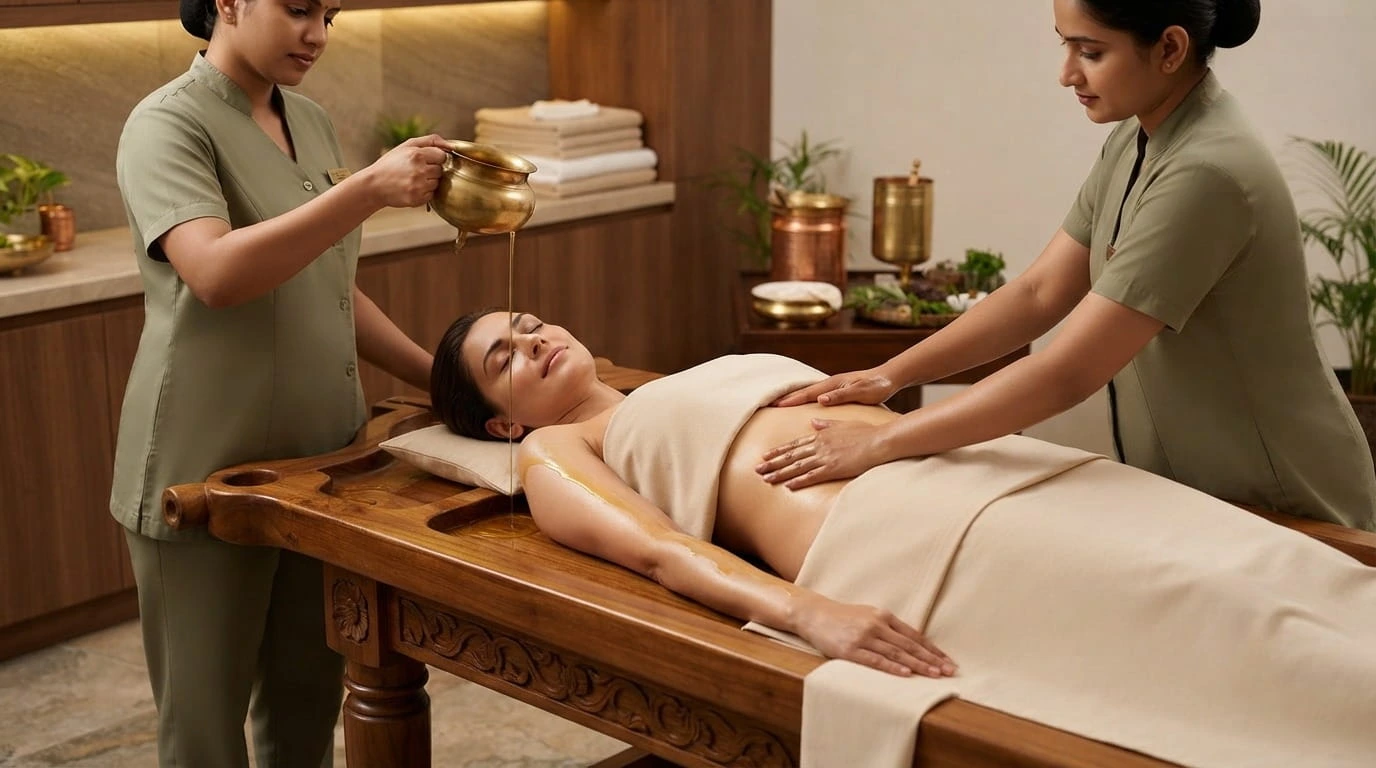
Sessions are supervised throughout by a trained practitioner.
How Is Pizhichil Performed?
A responsible Pizhichil session generally follows a structured sequence, though the specific details are set by the practitioner based on your assessment:
Step 1 — Ayurvedic consultation
The practitioner reviews your main concerns, medical history, current medications, previous treatments, skin sensitivity, and any relevant health conditions.
Step 2 — Treatment planning
Based on the consultation, the practitioner determines whether Pizhichil is an appropriate therapy for you at this time, or whether another approach may be more suitable.
Step 3 — Preparation
The selected oil or liquid is prepared according to the protocol chosen for your session.
Step 4 — Positioning
You are comfortably positioned, typically lying down, in a way that allows the therapist to work over the treatment area safely.
Step 5 — Warm liquid application
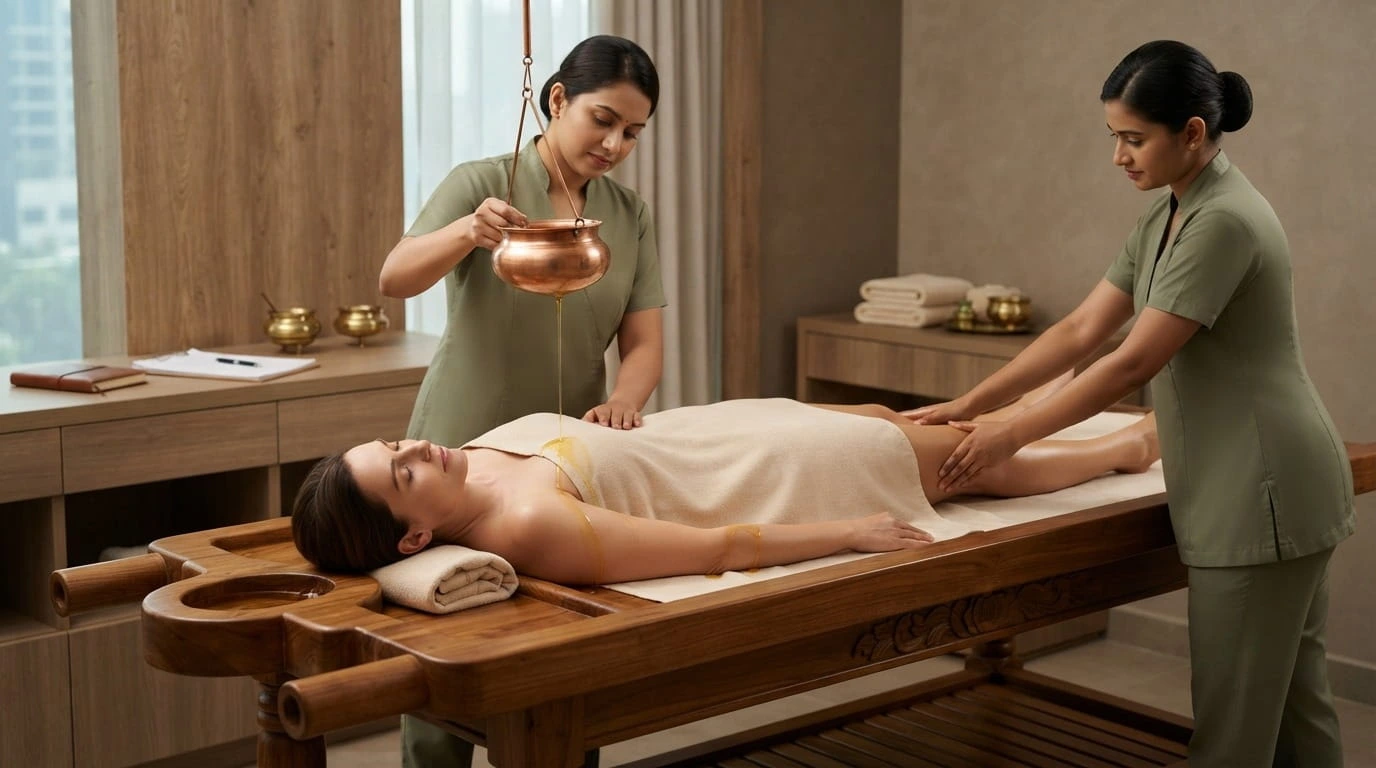
The warm liquid is poured in a controlled, rhythmic stream over the designated area or areas.
Step 6 — Gentle massage
Depending on the protocol, gentle massage strokes may accompany the pouring, working the oil into the skin.
Step 7 — Temperature and comfort monitoring
The practitioner monitors your comfort throughout, adjusting temperature or pace as needed and checking in with you directly.
Step 8 — Completion
The session concludes according to the plan set out for you, rather than a fixed universal endpoint.
Step 9 — Post-treatment guidance
You receive individualized aftercare guidance based on how your body responded and what the practitioner recommends going forward.
A rhythmic, monitored pour is central to the Pizhichil technique.
APPLICATION AREA
Is Pizhichil a Full-Body Treatment?
Classical descriptions of Pizhichil often refer to full-body application, and this is the traditional association most people have with the therapy. In practice, though, the treatment area and overall protocol can vary from patient to patient. Some sessions may focus on particular regions of the body rather than the entire body, depending on what the practitioner determines is appropriate.
It would be inaccurate to say every Pizhichil session is necessarily full-body — the treating Ayurvedic practitioner decides the right approach for you after assessment.
Pizhichil for Musculoskeletal & Wellness Concerns
Below are the primary physical and wellness areas for which Pizhichil may be explored following an individual Ayurvedic consultation.
Pizhichil for Muscle Stiffness
Some patients explore Pizhichil as part of a broader Ayurvedic programme when dealing with muscle stiffness, general physical tension, or a reduced sense of bodily ease. In traditional Ayurvedic use, warm oil therapies of this kind are associated with comfort and relaxation in the muscles, and may be considered by a practitioner as one component of a wider care plan. This should not be read as a claim that Pizhichil cures muscle pain or resolves an underlying musculoskeletal condition. If stiffness is persistent, worsening, or linked to an injury, it deserves proper assessment — whether Ayurvedic, physiotherapeutic, or medical — rather than being addressed through a single therapy in isolation.
Pizhichil for Joint Stiffness
Patients sometimes ask about Pizhichil in the context of joint-related discomfort, including knee stiffness, shoulder stiffness, or general joint tightness. Traditionally, warm oil therapies have a place within Ayurvedic approaches to joint comfort, but the underlying cause of joint stiffness always needs to be properly assessed first. Pizhichil should not be understood as a substitute for the diagnosis or medical management of conditions such as arthritis. If you are living with a diagnosed joint condition, any Ayurvedic therapy should be considered alongside — not instead of — appropriate medical care and follow-up.
Pizhichil and Back Discomfort
Some patients look into warm oil therapies such as Pizhichil as part of Ayurvedic care for back discomfort connected to muscular tension or general stiffness. It is worth being clear, however, that not all back pain is muscular in origin, and persistent or severe back pain should always be medically assessed before assuming a wellness-oriented therapy is the right first step. Certain symptoms alongside back pain warrant prompt medical attention rather than a wellness appointment. These include leg or arm weakness, numbness, loss of bladder or bowel control, fever, a history of major trauma, unexplained weight loss, or symptoms that are rapidly worsening. If any of these apply to you, please seek medical care first.
Pizhichil and Neck or Shoulder Stiffness
Neck and shoulder discomfort linked to muscular tension, general stiffness, or postural strain is one context in which patients sometimes explore Pizhichil as part of Ayurvedic wellness care. It should not, however, be presented as a treatment for cervical spine disorders. If neck or shoulder discomfort is accompanied by neurological symptoms — such as numbness, tingling, or weakness radiating down the arm — appropriate medical assessment should come first.
Pizhichil for Relaxation
Beyond specific physical concerns, many patients consider Pizhichil primarily for the relaxation experience itself. The combination of sustained warmth, the rhythmic flow of oil, gentle touch, and a quiet treatment environment is often described as calming. This is a reasonable and common reason to seek the therapy as part of a broader Ayurvedic wellness programme. At the same time, Pizhichil should not be promoted as a treatment for anxiety, depression, or insomnia. These are clinical conditions that deserve proper diagnosis and, where appropriate, evidence-based medical or psychological care. A relaxing Ayurvedic session and the treatment of a diagnosed mental health condition are not the same thing.
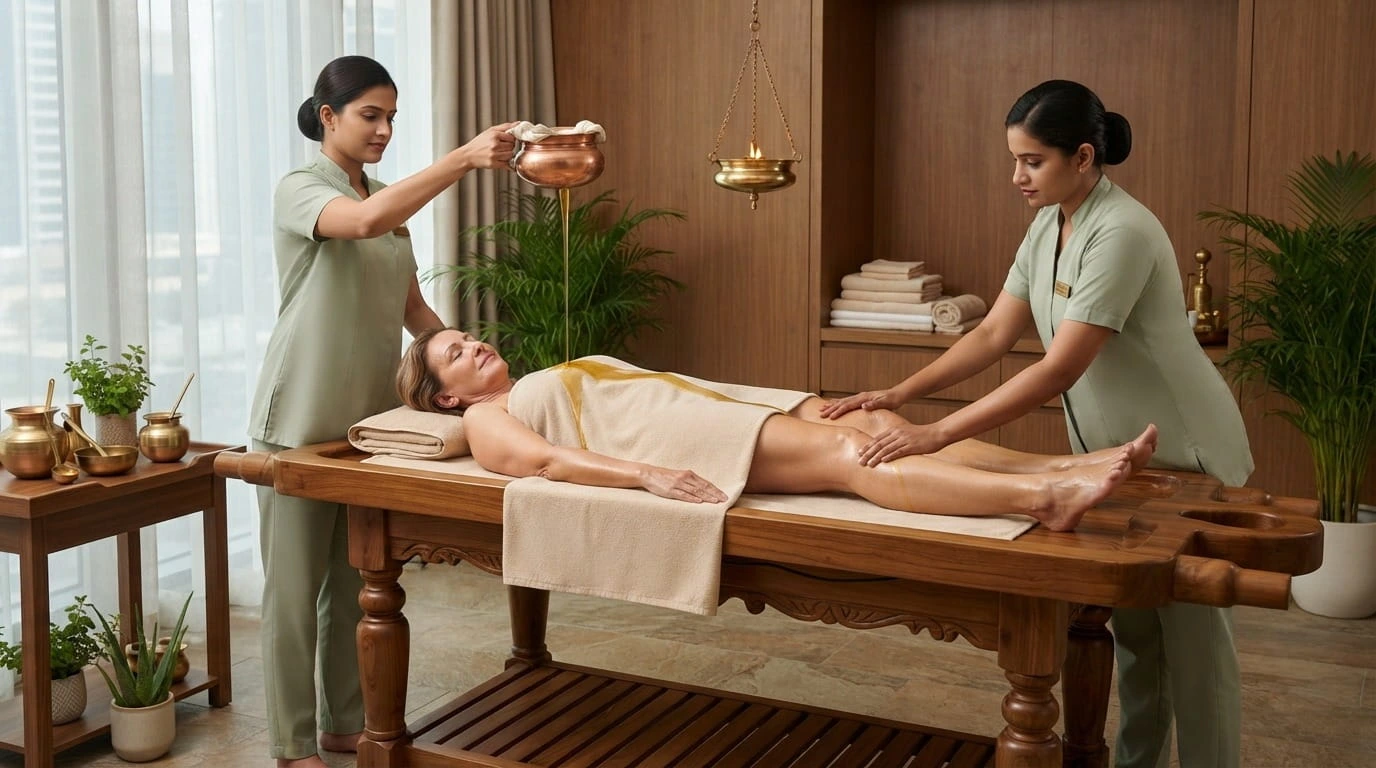
Pizhichil may be explored for muscle stiffness, joint stiffness, back & neck discomfort, and relaxation.
TRADITIONAL FRAMEWORK
Pizhichil and Ayurvedic Dosha Assessment
Ayurveda works within a framework of Vata, Pitta and Kapha — the three doshas — along with concepts such as Prakriti (an individual’s baseline constitution) and Vikriti (their current state of imbalance). A practitioner may draw on this framework when deciding whether Pizhichil is suitable for you, and if so, how it should be tailored.
It is important to understand that dosha assessment belongs to the traditional Ayurvedic system of thought and is not a medically validated diagnostic method in the biomedical sense. This page presents it as part of how Ayurvedic practitioners reason about treatment selection, not as an alternative to medical diagnosis.
PROGRAMME INTEGRATION
Pizhichil and Panchakarma
Pizhichil is sometimes included as one component within broader Ayurvedic treatment programmes, including some forms of Panchakarma. However, receiving Pizhichil does not automatically mean a patient is undergoing Panchakarma. Panchakarma refers to a wider group of classical Ayurvedic procedures aimed at a structured, multi-step approach to care, and whether it is appropriate for a given patient depends entirely on individual assessment.
If you are interested in a more comprehensive Ayurvedic programme rather than a single therapy, it may be worth discussing Panchakarma in JVC with your practitioner to understand how Pizhichil might or might not fit into that kind of plan.
HOW IT COMPARES
Pizhichil and Related Therapies
Patients often want to understand how Pizhichil differs from other therapies they may have heard of. Below are clear, honest comparisons.
Summary Comparison of Pizhichil & Related Therapies
| Therapy | Primary Focus & Method | Application & Area |
|---|---|---|
| Pizhichil | Continuous warm medicated oil stream poured with rhythmic massage | Full body or targeted areas |
| Abhyanga | Traditional warm oil hands-on massage without continuous pouring | Full body |
| Shirodhara | Continuous controlled stream of warm oil directed at the forehead | Head & forehead specific |
| Njavarakizhi | Warm herbal rice-based boluses (kizhi) massaged over body | Full body or targeted joints |
| Kativasti | Warm medicated oil retained inside dough dam | Lower back / lumbar specific |
| Physiotherapy | Clinical rehabilitation, movement retraining & active exercise | Targeted joint & muscle rehabilitation |
Suitability and choice of therapy depend entirely on an individual clinical and Ayurvedic assessment.
Pizhichil vs Abhyanga
Both therapies use Ayurvedic oil, which leads to understandable confusion.
Abhyanga is primarily an Ayurvedic oil massage — the emphasis is on hands-on massage technique using oil as a medium.
Pizhichil adds a continuous or repeated stream of warm liquid poured over the body, with massage often performed alongside it rather than being the sole focus.
In short, Abhyanga centres on massage; Pizhichil centres on the combination of pouring and massage together.
Pizhichil vs Shirodhara
These two therapies are sometimes confused because both involve a controlled pour of liquid.
Pizhichil generally involves warm oil or liquid applied over larger areas of the body.
Shirodhara directs a controlled stream specifically toward the forehead and head region.
The two have different traditional purposes and produce a noticeably different treatment experience — Shirodhara is centred on the head, while Pizhichil is broader in scope.
Pizhichil vs Njavarakizhi
Both therapies involve warmth applied to the body, but the technique and materials differ substantially.
Pizhichil uses warm medicated oil or liquid poured over the body in a controlled stream.
Njavarakizhi uses warm herbal or rice-based boluses (kizhi) applied and massaged over selected body areas rather than a poured liquid.
The sensory experience, the materials used, and the traditional applications of the two therapies are different, even though both fall within the broader category of Ayurvedic thermal therapies.
Pizhichil vs Kativasti
Patients sometimes ask how Pizhichil compares to more localized oil-retention therapies.
Pizhichil typically involves oil or liquid poured over larger or selected areas of the body in a continuous stream.
Kativasti involves warm medicated oil held in place over a specific area, most commonly the lower back, using a dam made of dough or a similar material, rather than being poured continuously.
Which of the two is more appropriate depends on whether the practitioner’s assessment points toward a broader, flowing application or a localized, retained one.
Pizhichil vs Physiotherapy
This comparison matters because the two sit in genuinely different frameworks of care.
Pizhichil is a traditional Ayurvedic therapy, rooted in classical concepts of oleation, fomentation and constitutional balance.
Physiotherapy is a clinical rehabilitation discipline focused on movement, strength, mobility, functional recovery, targeted exercise and evidence-based physical rehabilitation.
Some patients use both, under appropriate professional guidance, as part of a broader care plan. However, Pizhichil should not be presented as a replacement for physiotherapy or rehabilitation when rehabilitation is clinically indicated — for example, after injury, surgery, or in the management of a diagnosed musculoskeletal condition.
SUITABILITY
Who May Consider Pizhichil?
Following professional assessment, some patients may explore Pizhichil for reasons such as:
- ✓General muscle stiffness
- ✓Selected joint stiffness
- ✓Physical tension and tightness
- ✓General body discomfort
- ✓Relaxation and stress relief
- ✓Rejuvenation-oriented care within a broader Ayurvedic programme
Suitability is always determined case by case — this therapy is not positioned as appropriate for every person or every concern.
CONTRAINDICATIONS
Who Should Avoid or Delay Pizhichil?
Certain situations may mean that Pizhichil needs to be postponed, modified, or cleared by a doctor before proceeding. These can include:
- !Fever
- !Acute infection
- !Open wounds
- !Active skin infection
- !Significant skin irritation
- !Reduced sensation to heat
- !Certain cardiovascular conditions
- !Uncontrolled medical conditions
- !Acute injury
- !Significant active inflammation
- !Pregnancy or other special individual circumstances requiring medical clearance
This list is illustrative rather than exhaustive. It is not a substitute for a full medical and Ayurvedic history review during consultation.
Heat and Burn Safety
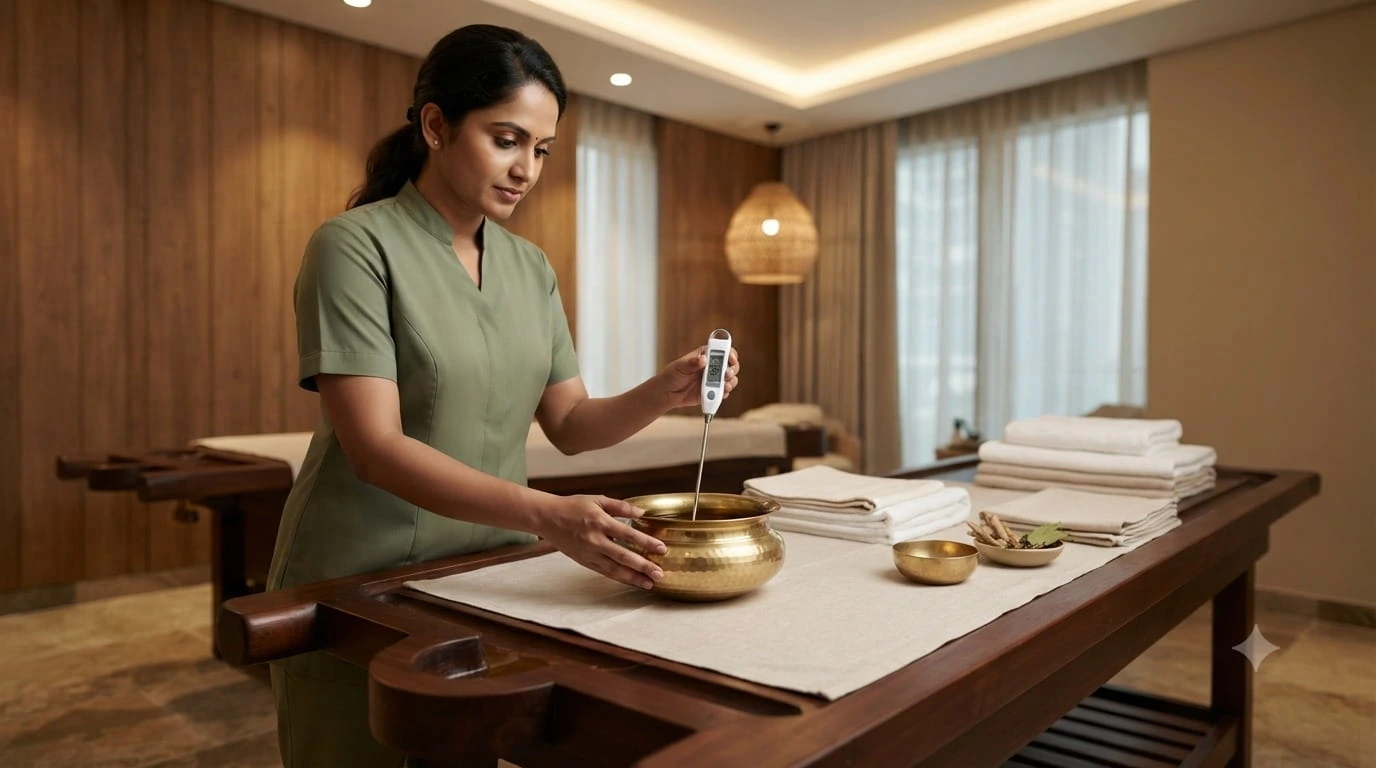
Because Pizhichil involves warm liquid applied continuously over the skin, careful temperature control is essential. Potential problems if this is not managed properly include:
Risk Factor 1
Burns
Risk Factor 2
Skin irritation
Risk Factor 3
Excessive heat exposure
Risk Factor 4
Dizziness
Risk Factor 5
Dehydration or general discomfort
Temperature control begins before the session, not during it.
Preparing for Your Pizhichil Session
A few practical steps can help your session go smoothly. Follow any instructions given by the clinic ahead of your visit. Tell your practitioner about existing medical conditions, current medication, known allergies, and any skin sensitivity you have.
Wear or bring clothing suitable for an oil-based treatment, since oil can mark fabric. If the clinic advises against arriving immediately after strenuous physical activity, follow that guidance. These are general good practices rather than fixed clinic-specific rules — always defer to the specific instructions Vedara Care provides you directly.
Aftercare
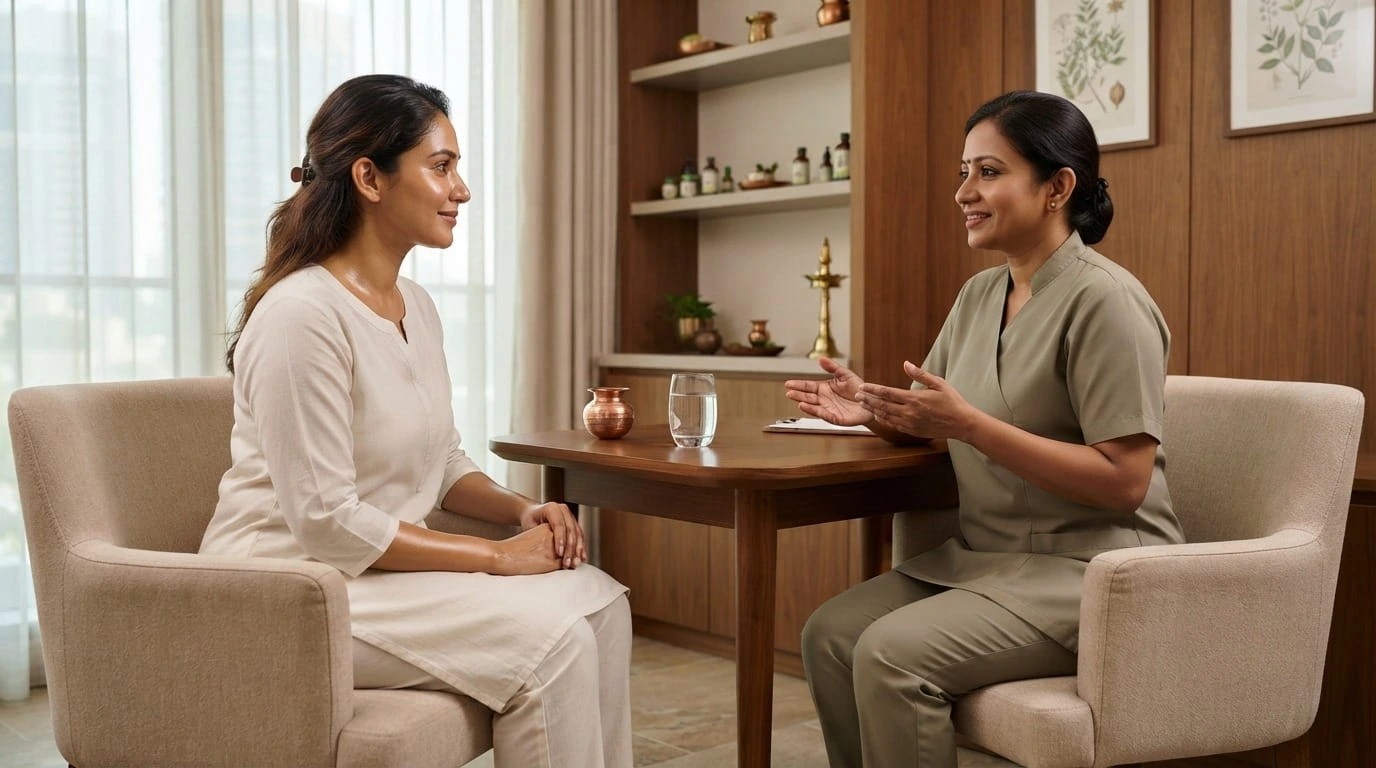
After your session, allow yourself some time to rest rather than rushing straight into a demanding activity. Follow whatever specific instructions your practitioner gives you.
Guidance
If advised, avoid sudden exposure to extreme temperatures immediately afterward. Maintain your normal hydration unless you have been medically advised otherwise, and follow any dietary guidance your practitioner provides. These are general principles, not rigid universal rules — your aftercare should reflect what your practitioner recommends for you specifically.
Aftercare guidance is individualized, not one-size-fits-all.
Pizhichil Recovery
Pizhichil does not typically involve the kind of structured recovery period associated with a surgical procedure. That said, it is common to notice some temporary effects after a session, such as lingering warmth, a feeling of relaxation, oily skin, mild tiredness, or light sweating.
Individual responses can differ, and what one patient notices afterward will not necessarily match another’s experience.
Sessions and Duration
There is no fixed number of sessions that applies to everyone. How many sessions might be appropriate depends on the practitioner’s Ayurvedic assessment, the nature of your concern, the objective of treatment, whether Pizhichil is being used as a standalone therapy or as part of a larger Ayurvedic programme, and how you respond as treatment progresses. Be cautious of any claim promising that a specific number of sessions will guarantee a particular result — that is not how individualized Ayurvedic care works.
Session duration varies according to the protocol chosen, the treatment area involved, preparation requirements, individual patient needs, and whether Pizhichil is combined with other therapies in the same visit. Because these factors differ from patient to patient, we do not state a fixed session length — your practitioner will confirm the expected duration for your specific treatment plan during consultation.
PRICING & INVESTMENT
Pizhichil Cost in Dubai
Pricing for Pizhichil Therapy in JVC, and for Pizhichil treatment cost more broadly across Dubai, depends on several factors:
Because these variables differ by patient, we do not quote a fixed price on this page. For current pricing, please contact Vedara Care Polyclinic directly.
CHOOSING A CLINIC
Why Choose Pizhichil Therapy in JVC?
Choosing where to receive Pizhichil Therapy in JVC is worth thinking through carefully, given that it involves warm liquid applied directly to the skin over a sustained period:
- ✓A genuine professional assessment before treatment begins
- ✓Personalization of therapy to your constitution and concerns rather than a single fixed routine
- ✓Convenient location for JVC and surrounding Dubai communities (Al Barsha South, Motor City, JVT)
- ✓Clear explanations of what the therapy does and does not do
- ✓Supervision by trained BAMS-qualified practitioners throughout
- ✓Strict temperature monitoring and heat safety protocols
Individualized treatment planning, rather than a one-size-fits-all approach, is the standard worth expecting from any Ayurvedic clinic offering this therapy.
CLINIC EXCELLENCE
Why Choose Vedara Care Polyclinic?
Vedara Care Polyclinic presents its Ayurveda service in JVC as being delivered by BAMS-qualified practitioners, with individualized Ayurvedic assessment carried out before therapies are recommended. This approach — assessment first, treatment second — is the same standard applied to how Pizhichil is offered at the clinic.
- ✓Delivered by BAMS-qualified Ayurvedic doctors
- ✓Individualized assessment before any treatment recommendation
- ✓Transparent medical limits and safety protocols
- ✓Multidisciplinary facility supporting referrals to physiotherapy or medical doctors when needed
- ✓Convenient JVC location at Binghatti Azure
Patients considering the therapy are encouraged to verify current specifics such as practitioner availability and session details directly with the clinic.
Frequently Asked Questions About Pizhichil Therapy
Answers to common questions about Pizhichil Therapy, Sarvanga Dhara terminology, oil selection, session protocol, recovery, suitability and cost in JVC, Dubai.
Book ConsultationRELATED CONDITIONS AND TREATMENTS
Related Conditions and Treatments
Pizhichil is rarely considered in isolation. Depending on your concerns, an Ayurvedic practitioner may discuss it alongside other therapies or as part of a broader treatment plan. If you are exploring Ayurveda more generally, the Ayurveda Clinic in JVC page offers a wider overview of the services available, while Ayurveda in Dubai covers the practice across the city more broadly.
For patients interested in a more comprehensive, multi-step Ayurvedic approach, Panchakarma in JVC describes a structured programme that may, in some cases, include therapies similar to Pizhichil. Those specifically curious about massage-based Ayurvedic care can read about Abhyanga, while Shirodhara explains the related but distinct head-focused pouring therapy. Patients weighing warmth-based options may also want to compare Njavarakizhi, which uses herbal boluses rather than poured liquid, or Kativasti, a localized oil-retention therapy often considered for lower back concerns.
If your primary concern is a specific condition rather than a specific therapy, it may be more useful to start with a condition page. These include Back Pain (Ayurveda), Back Pain (Physiotherapy), Arthritis (Ayurveda), and Frozen Shoulder. Where a condition is primarily musculoskeletal and involves movement, strength or functional limitation, Physiotherapy in JVC is a separate, evidence-based service that may be more directly appropriate, either instead of or alongside Ayurvedic care.
Pizhichil Therapy in Jumeirah Village Circle
For residents of JVC and nearby areas such as Al Barsha South, accessing traditional Ayurvedic therapies close to home can make it easier to follow through on a treatment plan that may involve more than one visit. Vedara Care Polyclinic is located at Al Barsha South Fourth, Binghatti Azure, Shop -4, Jumeirah Village Circle (JVC), Dubai, UAE, offering Pizhichil Therapy alongside a wider range of Ayurvedic services for patients across JVC and the broader Dubai area. Whether you are new to Ayurveda or have experience with therapies such as Abhyanga or Panchakarma elsewhere, a proper consultation is the starting point for understanding whether Pizhichil fits your particular situation.
Vedara Care Polyclinic, Al Barsha South Fourth, Binghatti Azure, JVC, Dubai
GET IN TOUCH
Book a Pizhichil Therapy Consultation at Vedara Care Polyclinic
NEARBY LANDMARKS
- ✓Binghatti Azure building, Al Barsha South Fourth
- ✓Near JVC Circle roundabout, accessible from Hessa Street and Al Khail Road
DISTANCE FROM DUBAI COMMUNITIES
Important Information
Medical Disclaimer
The information provided on this page is for general educational purposes and does not replace individualized medical or Ayurvedic advice. Pizhichil may not be appropriate for every person or every health concern. A qualified healthcare professional should assess your medical history, symptoms and treatment goals before recommending an appropriate therapy.
READY TO START?
Explore Pizhichil Therapy in JVC
If you are considering Pizhichil Therapy in JVC, the best next step is a proper conversation with an Ayurvedic practitioner — not a self-diagnosis based on what you have read here. At your consultation with Vedara Care Polyclinic, be ready to discuss your main symptoms, your medical history, any medication you are currently taking, your skin sensitivity, existing health conditions, and what you are hoping to achieve. Your practitioner will help you understand whether Pizhichil is a suitable option for you, or whether another Ayurvedic or medical approach would serve you better.
EXPLORE MORE
Related Ayurvedic Services in JVC
Ayurveda Clinic in JVC
Full range of traditional Ayurvedic therapies and consultations in JVC.
Learn moreAyurvedic Treatment in Dubai
Overview of Ayurvedic services offered by Vedara Care Polyclinic across Dubai.
Learn moreAbhyanga in Dubai
Traditional full-body Ayurvedic oil massage, often compared with Pizhichil.
Learn moreShirodhara in Dubai
Head-focused continuous warm oil pouring therapy.
Learn moreNjavarakizhi in Dubai
Traditional warm herbal rice bolus therapy.
Learn moreKativasti in Dubai
Localized warm-oil retention therapy for the lower back.
Learn morePanchakarma in JVC
Comprehensive Ayurvedic detoxification and rejuvenation procedures.
Learn morePatra Pinda Sweda in JVC
Traditional Ayurvedic herbal bolus fomentation therapy.
Learn moreNasya Therapy in JVC
Traditional Ayurvedic nasal administration therapy.
Learn morePhysiotherapy in JVC
Structured rehabilitation, strength, mobility and postural retraining services.
Learn more