Patra Pinda Sweda Therapy in JVC | Vedara Care
Patra Pinda Sweda Therapy in JVC is a traditional Ayurvedic fomentation therapy in which warm herbal boluses — cloth bundles filled with selected leaves and herbs — are gently applied to the body. Controlled warmth and gentle application are central to this therapy, which Ayurveda has traditionally used for selected musculoskeletal concerns such as stiffness, tension, and localized discomfort. Also known as Patra Pinda Swedana, Ela Kizhi, or Patra Potli Sweda, this therapy is never approached the same way for every patient at Vedara Care Polyclinic in Jumeirah Village Circle — each treatment plan follows an individualized Ayurvedic assessment before any bolus is prepared.
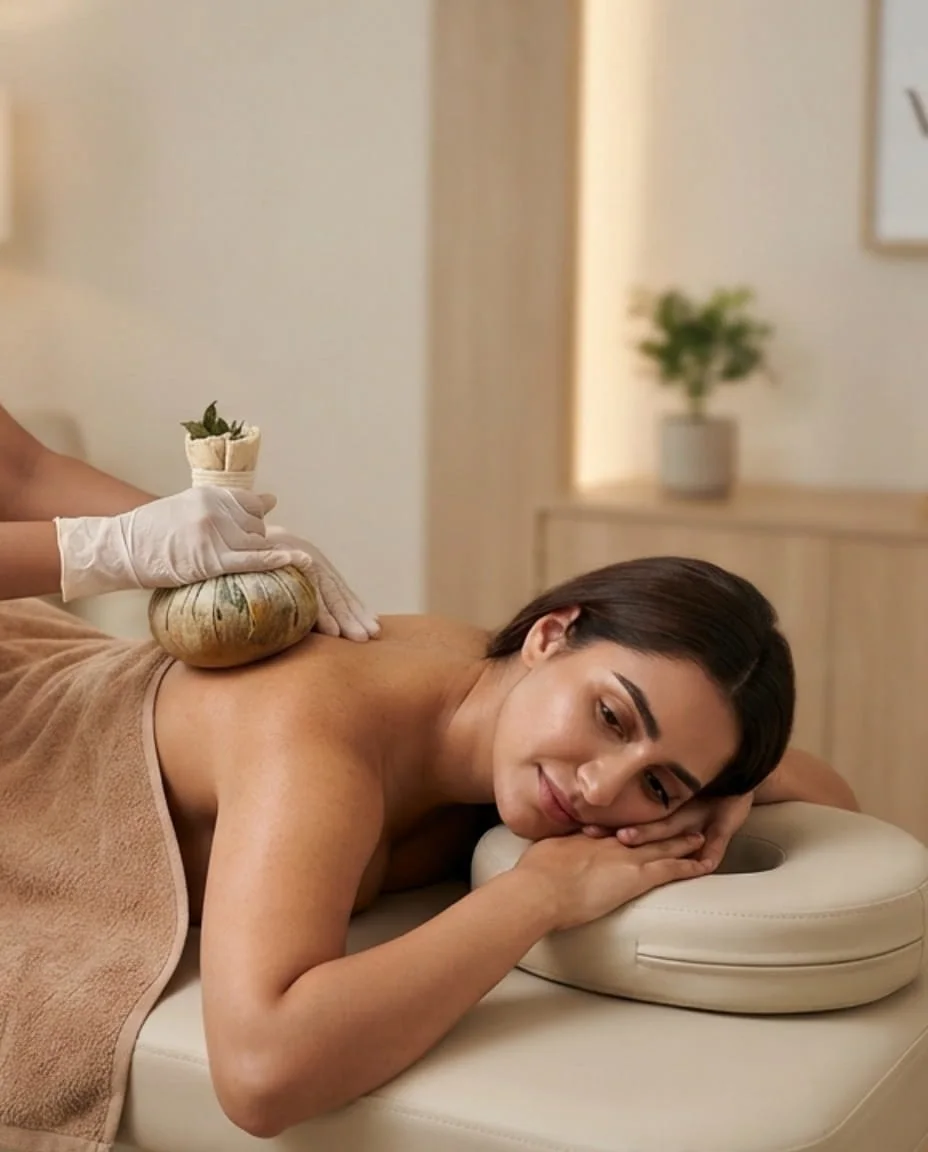
Warm Herbal Fomentation
Patra Pinda Sweda (Ela Kizhi / Patra Potli Sweda) is a traditional Ayurvedic therapy in which warm herbal boluses are gently applied to the body under practitioner supervision.
THE QUICK ANSWER
What is Patra Pinda Sweda Therapy in JVC?
Patra Pinda Sweda is a traditional Ayurvedic fomentation therapy in which selected herbs and leaves are prepared into warm cloth boluses and applied to appropriate areas of the body. The name itself describes the process: Patra means leaves, Pinda means a bolus or bundle, and Sweda (or Swedana) refers to therapeutic fomentation, often associated with a controlled sweating effect. Within Ayurveda, the warmth generated by the herbal bolus is traditionally believed to create a fomentation effect over the treated area, and the therapy has long been incorporated into Ayurvedic care for selected concerns involving pain, stiffness, and musculoskeletal tension. The specific herbs used, how the bolus is prepared, the temperature applied, the application technique, and the overall treatment duration can all vary depending on the practitioner’s protocol and the individual being treated. It’s important to be clear from the outset: this treatment should be selected only after an Ayurvedic practitioner has properly assessed you. Patra Pinda Sweda isn’t a generic, one-size-fits-all remedy, and its suitability for your specific concern depends on that individual evaluation.
Reviewed by Ayurveda Team, DHA-Licensed 2509266 · Last updated August 2026
What Is Patra Pinda Sweda?
Patra Pinda Sweda is a classical Ayurvedic therapy built around two core ideas: the therapeutic use of selected leaves and herbs, and the application of controlled warmth to the body. The herbs are prepared into small cloth bundles — the “boluses” or “pindas” — which are warmed and then applied to the skin over the treatment area, typically in a rhythmic, practitioner-guided pattern.
This therapy falls under the broader Ayurvedic category of Swedana, or fomentation therapy. Within Ayurvedic thought, Swedana refers to a range of techniques intended to introduce controlled warmth to the body, and Patra Pinda Sweda is one of several approaches within this category — distinguished by its use of herb-filled boluses rather than steam, oil alone, or other fomentation methods.
It’s worth being clear about what distinguishes this from an ordinary massage. While there may be an element of rhythmic application involved, the therapy centers on the combination of herbal content and controlled heat, rather than on deep manual pressure or manipulation alone. This is also why practitioner supervision matters throughout — maintaining a tolerable, safe temperature and selecting an appropriate protocol both require professional judgment, not something a patient should attempt to replicate on their own.
As with the other Ayurvedic therapies discussed on our site, it’s important to draw a clear line between traditional Ayurvedic rationale and modern scientific evidence. Ayurvedic texts describe Patra Pinda Sweda within a framework involving concepts such as dosha balance, which is a traditional system of thought rather than an established biomedical mechanism. We’ll refer to these traditional concepts where relevant throughout this page, but we won’t present them as proven medical facts.
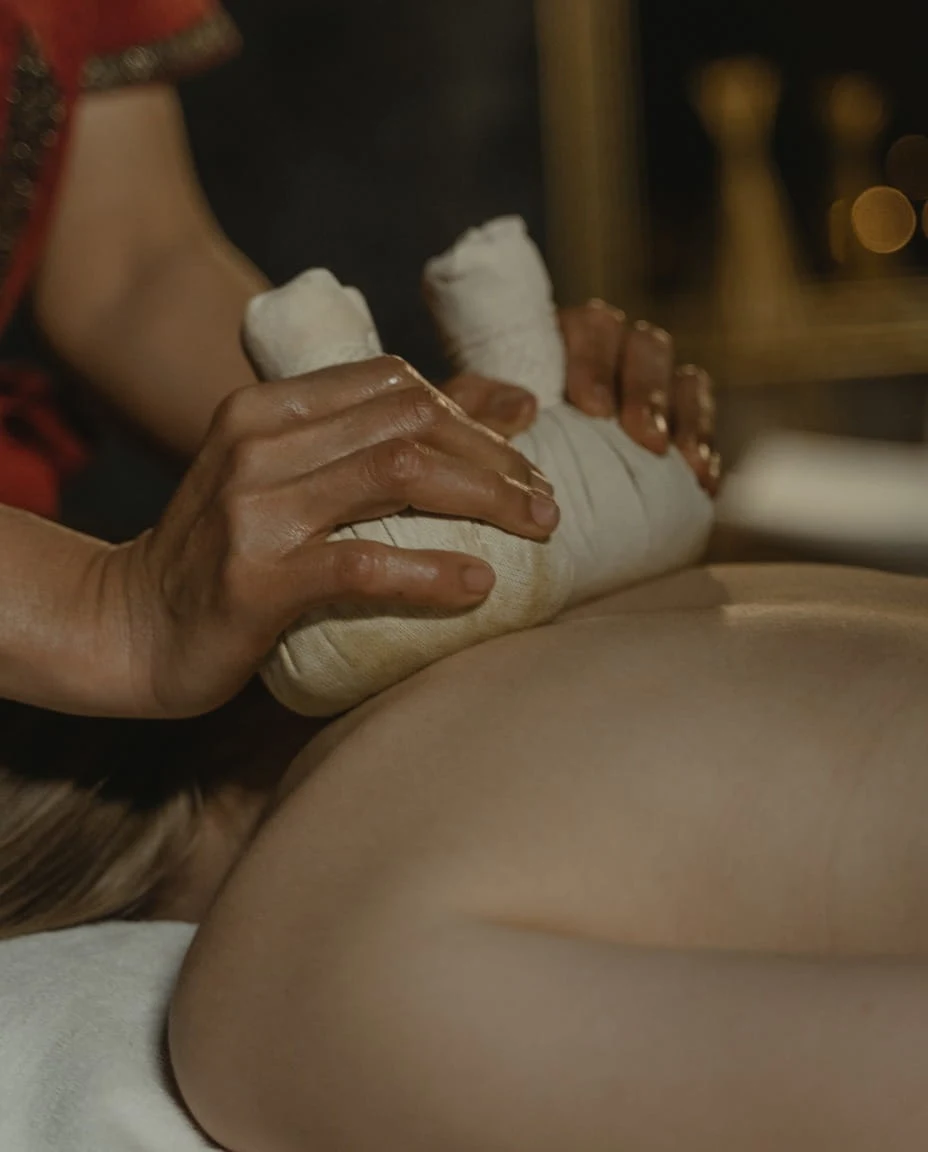
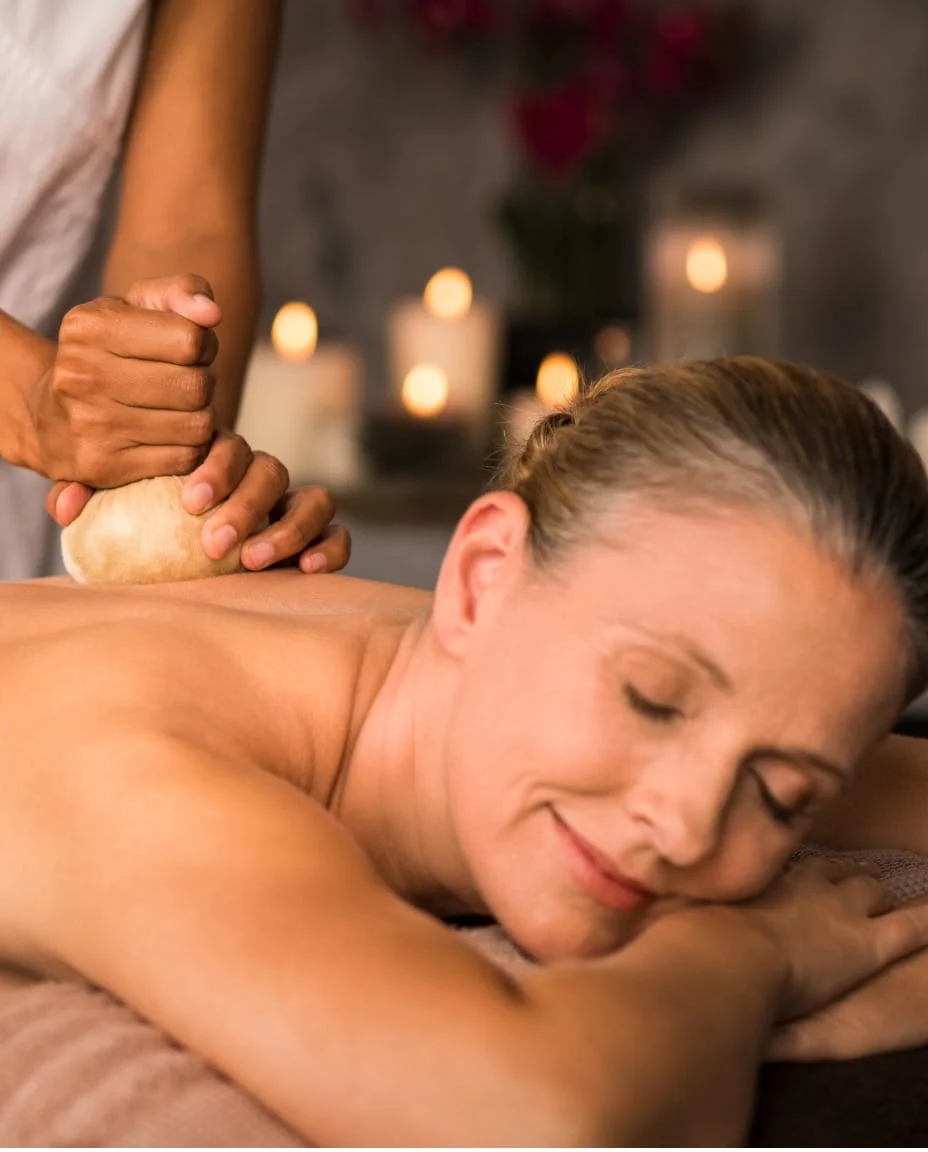
Warm herbal boluses are gently applied in a practitioner-guided pattern over the treatment area.
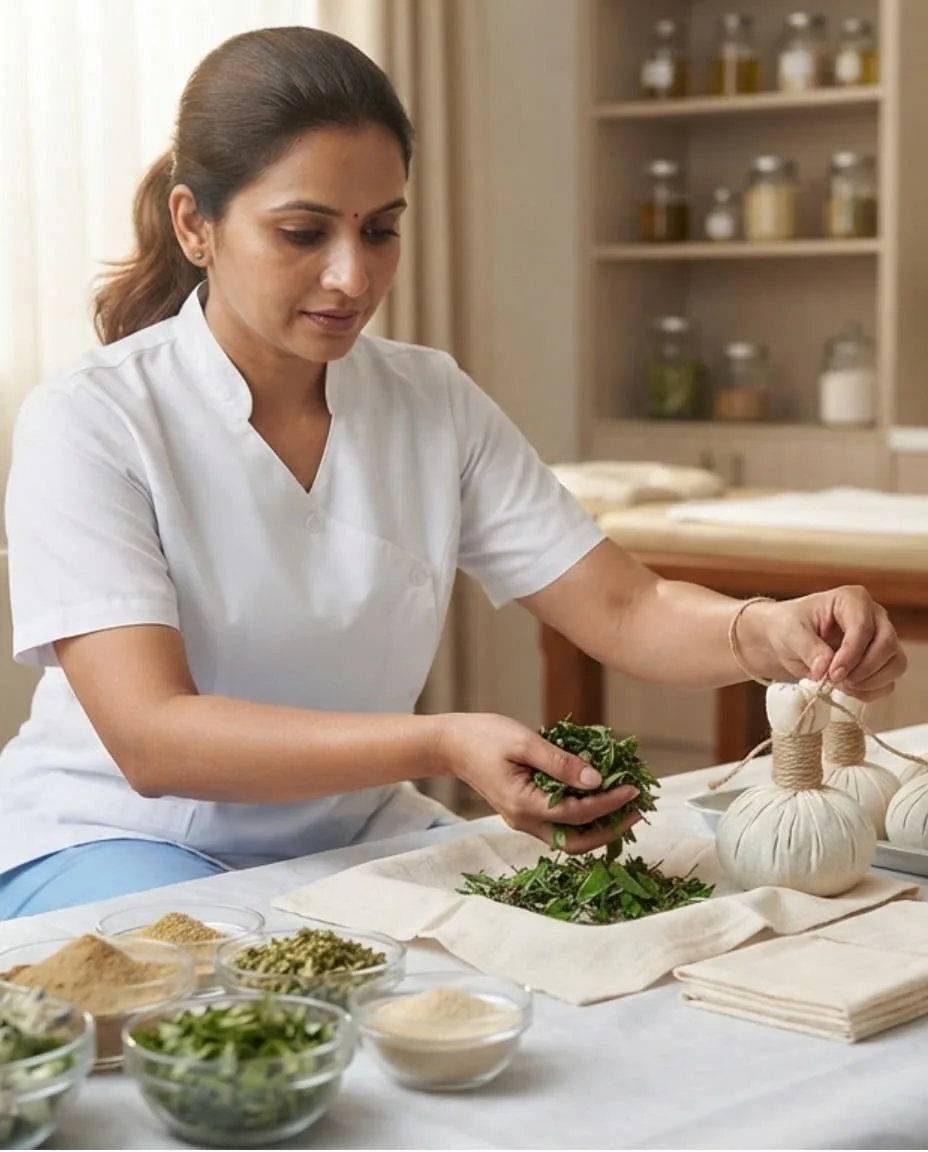
How Does the Herbal Bolus Work?
The general concept behind the herbal bolus involves several steps, described here at a conceptual level rather than as a set of instructions:
Step 1
Selected leaves and herbs are gathered and prepared according to the practitioner’s chosen protocol
Step 2
These are formed into a cloth bolus, allowing the herbs to be applied without direct loose contact with the skin
Step 3
The bolus is warmed under controlled conditions before application
Step 4
It is applied gently to the treatment area, often using a rhythmic technique
Step 5
The bolus may be re-warmed periodically throughout the session as needed
Step 6
The result is intended to create a localized warming and fomentation effect over the treated area
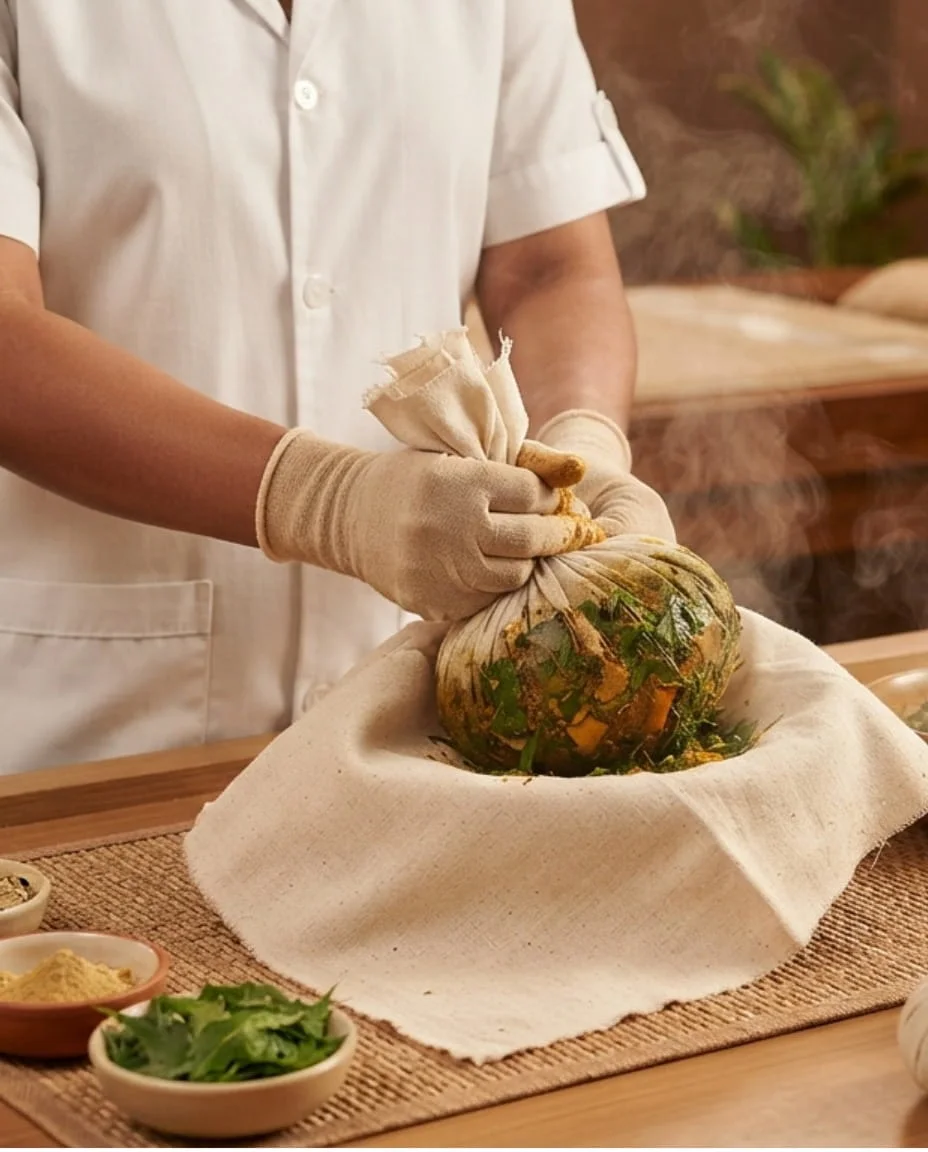
Herbal boluses are prepared individually for each treatment plan.
What Is Inside a Patra Pinda Bolus?
The exact composition of a Patra Pinda Sweda bolus can vary meaningfully between practitioners and protocols. Formulations may include selected medicinal leaves and other Ayurvedic ingredients, chosen based on several factors:
Factor 1
The specific objective of the treatment
Factor 2
The patient’s condition and presenting symptoms
Factor 3
The Ayurvedic assessment carried out during consultation
Factor 4
The body area being treated
Factor 5
The patient’s individual tolerance
Factor 6
The overall treatment plan the patient is following
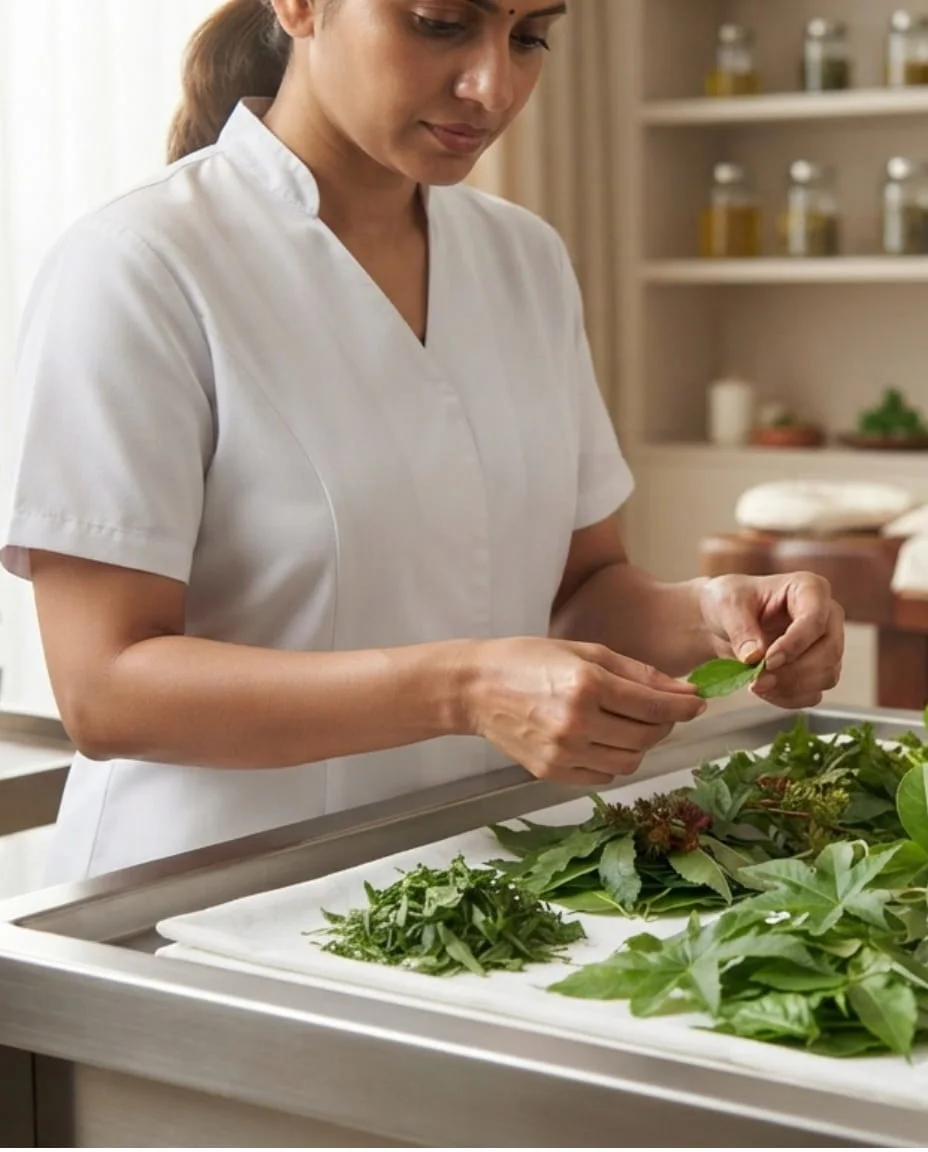
Selected leaves and herbs form the basis of the herbal bolus.
Patra Pinda Sweda for Musculoskeletal Concerns
Pain and stiffness are the main reasons patients typically look into Ayurvedic pain treatment JVC options, and Patra Pinda Sweda has a long traditional association with these concerns. Below are the primary conditions and symptoms for which Patra Pinda Sweda may be considered following an individual consultation.
Patra Pinda Sweda for Pain and Stiffness
Within Ayurvedic practice, the therapy may be considered for: General muscle stiffness, Joint stiffness, Localized areas of discomfort, Back discomfort, Shoulder stiffness, Neck stiffness, Reduced mobility associated with certain musculoskeletal conditions. We’re using careful language here deliberately: Patra Pinda Sweda may be considered for these concerns, and it is traditionally used within this context — it may support comfort for some patients. What we won’t say is that it cures arthritis, permanently removes inflammation, or repairs damaged joints, because none of that reflects an honest picture of what this therapy can be expected to do.
Patra Pinda Sweda for Frozen Shoulder
Frozen shoulder is a condition that can significantly restrict shoulder movement and cause considerable discomfort, and it’s one of the more specific concerns patients ask about in relation to this therapy. As with every condition discussed on this page, treatment should be individualized rather than assumed. Patra Pinda Sweda may be considered within a broader Ayurvedic programme for selected frozen shoulder patients, and it may be combined with other Ayurvedic approaches when a practitioner judges this appropriate for your case. We won’t present this as a guaranteed protocol that applies uniformly to every patient with frozen shoulder — what’s appropriate for you depends on your individual assessment. It’s also worth flagging that persistent shoulder pain or a significant, ongoing loss of movement may warrant medical or physiotherapy assessment, particularly if the condition isn’t improving or is affecting your daily function substantially.
Patra Pinda Sweda for Back Pain
Back pain is another common area of interest, and it’s worth being upfront that back pain can stem from a wide range of causes — some suited to a complementary Ayurvedic approach, and others requiring prompt medical attention. Patra Pinda Sweda may be considered, following assessment, for muscular stiffness, chronic back discomfort, or limited movement related to musculoskeletal tension. That said, please seek medical assessment rather than Ayurvedic therapy if you notice warning signs such as new weakness, numbness, loss of bowel/bladder control, fever, or trauma history.
Patra Pinda Sweda for Neck Stiffness
Neck stiffness can arise from muscular tension, postural habits, or underlying cervical conditions, and figuring out which applies to you matters for choosing the right treatment. Patra Pinda Sweda may be considered, following Ayurvedic assessment, for muscular or postural neck stiffness. However, severe neck pain, any neurological symptoms (such as numbness, tingling, or weakness in the arms), or neck pain following trauma all require medical evaluation rather than Ayurvedic therapy as a first step. For neck stiffness with a stronger musculoskeletal or postural component, our Physiotherapy in JVC service may also be worth discussing, either instead of or alongside Ayurvedic care.
Patra Pinda Sweda for Joint Stiffness
Joint stiffness can affect different areas of the body — the knee, shoulder, elbow, hands, or wrists — and, as with other symptoms on this page, understanding the underlying cause is an important first step. Patients sometimes ask about Patra Pinda Sweda for: Knee stiffness, Shoulder stiffness, Elbow discomfort, Hand or wrist stiffness, Other selected joint concerns. The cause behind joint stiffness matters considerably. Osteoarthritis, inflammatory arthritis, an acute injury, infection, and neurological problems can all present with joint stiffness, but they call for very different management approaches. Patra Pinda Sweda is not presented here as suitable for all of these — a practitioner assessment helps determine whether it has a role in your specific case.
Patra Pinda Sweda and Arthritis
Arthritis is not a single condition — it’s a broad term covering different underlying processes, some of which require ongoing medical management. Ayurvedic practitioners may incorporate Patra Pinda Sweda into an individualized care plan for selected arthritis-related stiffness and discomfort, but this page does not claim that Patra Pinda Sweda treats arthritis permanently, and no responsible clinic should make that claim. If you have diagnosed arthritis, particularly an inflammatory form, ongoing medical diagnosis and management remain important, and any Ayurvedic therapy you explore should be discussed within that broader context rather than as a replacement for it.
Patra Pinda Sweda for Muscle Tension
Many patients look into warm herbal fomentation therapy for more general reasons — muscle tightness, overall stiffness, physical fatigue, or a broader sense of musculoskeletal discomfort that doesn’t necessarily point to one specific diagnosis. This is a reasonable reason to explore Patra Pinda Sweda following assessment. We’d avoid language like “deep tissue detoxification” here, since that overstates what the treatment can be reliably shown to do. What can be said honestly is that Patra Pinda Sweda has a long traditional association with supporting comfort and relaxation in areas of muscular tension.
Patra Pinda Sweda may be considered for selected shoulder, back, neck, and joint concerns.
HOW IT COMPARES
Patra Pinda Sweda and Related Therapies
Patients often want to understand how Patra Pinda Sweda differs from other therapies they may have heard of. Below are clear, honest comparisons.
Summary Comparison of Warm Fomentation & Related Therapies
| Therapy | Primary Focus & Method | Body Area / Application |
|---|---|---|
| Patra Pinda Sweda | Warm herbal bolus fomentation (leaves & herbs in cloth bundle) | Selected body areas / localized or general |
| Ordinary Massage | Manual tissue pressure & manipulation without herbal heat bundles | Full body or targeted muscles |
| Abhyanga | Traditional warm medicated oil massage across broader body areas | Full body / broad coverage |
| Janu Basti | Retained reservoir of warm medicated oil inside dough dam | Knee joint specific |
| Kati Basti | Retained reservoir of warm medicated oil inside dough dam | Lower back / lumbar region specific |
| Physiotherapy | Evidence-based clinical rehabilitation, movement retraining & exercises | Targeted joint & muscle rehabilitation |
Suitability and choice of therapy depend entirely on an individual clinical and Ayurvedic assessment.
Patra Pinda Sweda vs Ordinary Massage
It’s a fair question whether Patra Pinda Sweda is simply a variation on massage, so it’s worth explaining the distinction clearly.
Ordinary massage primarily involves manual pressure and manipulation of the soft tissue, using the hands (or sometimes tools) directly on the skin.
Patra Pinda Sweda combines traditional Ayurvedic massage and fomentation concepts with warm herbal boluses — the herb-filled bundles themselves, and the controlled heat they carry, are central to the therapy, not simply an add-on to manual technique. Some protocols may begin with an Abhyanga-style oil massage before the bolus application starts.
It wouldn’t be accurate to describe Patra Pinda Sweda simply as a form of “hot stone massage” — while both involve heat, the mechanism, ingredients, and traditional purpose are quite different.
Patra Pinda Sweda vs Abhyanga
Abhyanga and Patra Pinda Sweda are two of the more commonly discussed Ayurvedic therapies, and patients often want to understand how they differ.
Abhyanga is a traditional Ayurvedic oil massage, generally applied across a broader area of the body using warm medicated oil and manual technique.
Patra Pinda Sweda centers on warm herbal bolus-based fomentation, applied to selected areas with a focus on heat and herbal content.
Depending on your assessment, both therapies may be combined within a single Ayurvedic treatment plan — for instance, some frozen shoulder programmes may involve both approaches together. You can read more about the oil-massage side of this on our Abhyanga in JVC page.
Patra Pinda Sweda vs Janu Basti
Both of these therapies are well known within Ayurveda, but they work quite differently.
Patra Pinda Sweda uses warm herbal boluses, applied to selected body areas depending on the treatment plan.
Janu Basti creates a localized reservoir of warm medicated oil retained specifically around the knee.
Which of these — if either — is appropriate depends entirely on your symptoms and assessment. If your primary concern is knee-specific, our Janu Basti Treatment in JVC page has more detail on that particular therapy.
Patra Pinda Sweda vs Kati Basti
Kati Basti is another therapy patients sometimes ask about alongside Patra Pinda Sweda, particularly for back-related concerns.
Patra Pinda Sweda involves broader or more targeted herbal fomentation using warm boluses, which can be applied to various areas of the body depending on the treatment plan.
Kati Basti is a localized warm oil therapy specifically applied to the lower back, using a retained oil reservoir similar in concept to Janu Basti but focused on the lumbar region.
These two treatments have different procedures and different traditional applications, and a practitioner assessment helps determine which — if either — fits your particular back concern.
Patra Pinda Sweda vs Physiotherapy
This comparison matters for patient safety and realistic expectations, so it deserves direct treatment.
Patra Pinda Sweda is a traditional Ayurvedic supportive therapy, rooted in classical concepts of herbal fomentation and warmth.
Physiotherapy is an evidence-based rehabilitation discipline focused on strength, mobility, function, structured exercise, and movement retraining, typically guided by a clinical assessment of movement patterns and physical capacity.
Some patients may receive both approaches as part of a broader care plan, depending on clinical assessment and their specific condition. However, Ayurvedic therapy, including Patra Pinda Sweda, is not presented here as a substitute for physiotherapy, particularly where rehabilitation, strength-building, or structured movement retraining is the primary need.
How Patra Pinda Sweda Is Performed
While specifics vary by practitioner and individual case, a typical Patra Pinda Sweda session generally follows this general patient journey:
Step 1 — Consultation
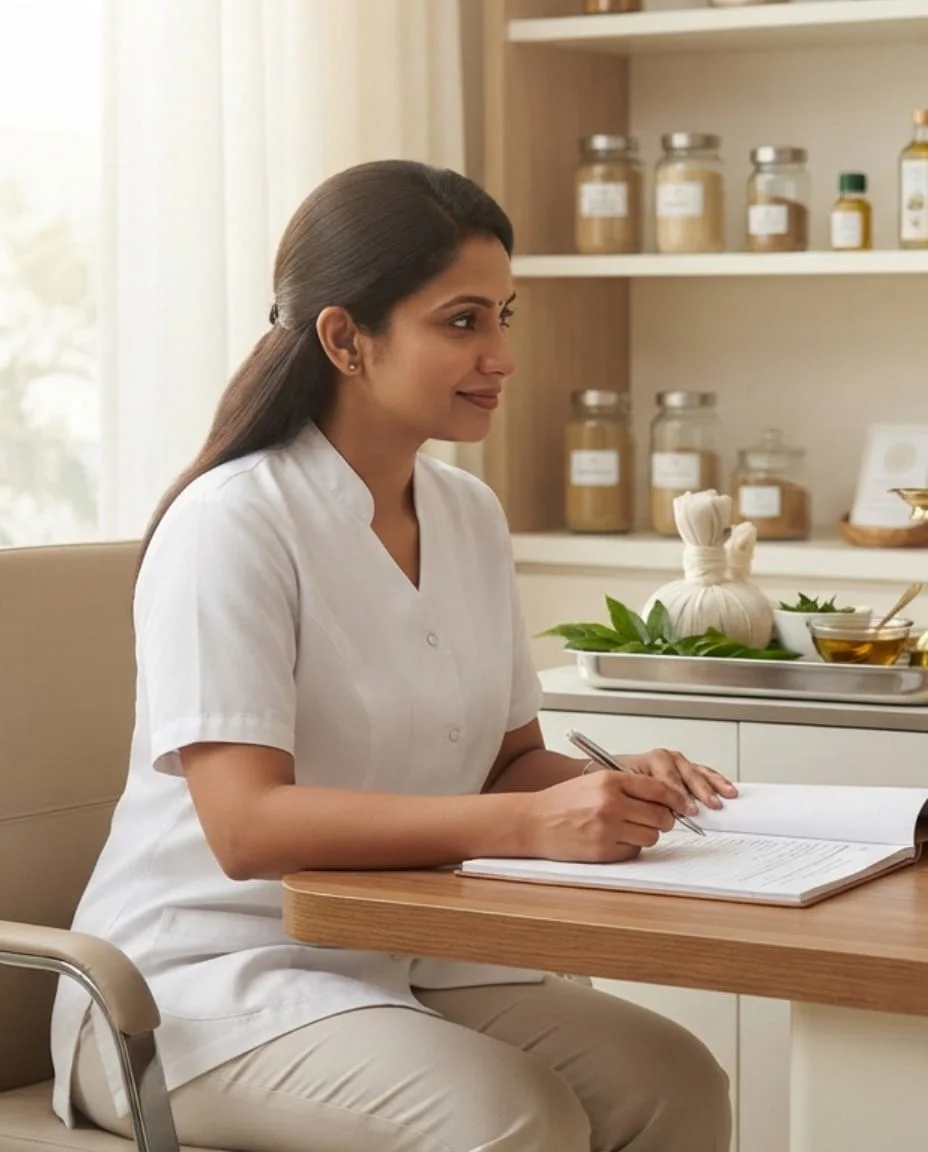
The practitioner reviews your main concern, how long you’ve had it, your medical history, previous injuries, current medications, skin sensitivity, and any other relevant conditions.
Step 2 — Treatment Planning
Based on this assessment, the practitioner selects the appropriate treatment area and Ayurvedic protocol for your case.
Step 3 — Preparation
The herbal boluses are prepared according to the chosen protocol ahead of the session.
Step 4 — Optional Abhyanga
Some protocols may include an oil massage before the fomentation stage begins, though this isn’t necessarily part of every patient’s plan.
Step 5 — Bolus Application
The warm boluses are applied gently to the selected treatment area, often in a rhythmic pattern.
Step 6 — Temperature Monitoring
The practitioner or therapist actively monitors the temperature to keep it within a comfortable, tolerable range throughout.
Step 7 — Completion
The session concludes once the planned protocol has been carried out.
Step 8 — Post-Treatment Guidance
You’ll typically receive individualized aftercare advice specific to your treatment and condition.
Every treatment plan begins with an individual consultation.
PATIENT EXPERIENCE
What to Expect During & After Treatment
What Does Patra Pinda Sweda Feel Like?
Most patients describe a combination of sensations during Patra Pinda Sweda, including: • A gradual sense of warmth over the treated area • Gentle pressure as the bolus is applied • Mild sweating in the treated area • A noticeable herbal aroma • An overall sense of relaxation • Temporary warmth of the skin that continues briefly after treatment The heat involved should remain within a tolerable range throughout the session — this isn’t meant to be an uncomfortably hot experience. If you notice burning, significant pain, dizziness, or excessive discomfort at any point, you should tell the practitioner immediately so they can adjust or stop the treatment.
Does Patra Pinda Sweda Hurt?
Patra Pinda Sweda is not meant to involve aggressive pressure, and significant pain is not an expected part of a properly performed session. That said, individual sensitivity to heat and touch varies from person to person, so what feels mild to one patient may feel stronger to another. Temperature should be actively monitored by the practitioner throughout the session, and mild warmth is a normal, expected part of the experience. Burning or significant pain, however, is not something to simply tolerate — if this happens, it should be reported right away so the treatment can be adjusted.
How Long Does a Session Take?
Session duration isn’t fixed and depends on several factors: the specific body area being treated, the treatment protocol selected for you, how the boluses are prepared, whether Abhyanga is included as part of your session, and your individual needs as assessed during consultation. Rather than quoting an exact duration that may not apply to your case, your practitioner will walk you through the expected time commitment for your specific treatment plan.
How Many Sessions May Be Needed?
There’s no universal number of sessions that fits every patient. Your treatment plan may depend on:
- ✓The specific condition being addressed
- ✓How long you’ve had your symptoms
- ✓The Ayurvedic assessment carried out during consultation
- ✓How you respond to initial treatment
- ✓Whether other Ayurvedic therapies are included alongside Patra Pinda Sweda
We won’t promise “results after 3 sessions” or any similar fixed timeline, because honest treatment planning doesn’t work that way — your practitioner will discuss a proposed plan with you, understanding that it may be adjusted as treatment progresses.
Patra Pinda Sweda Recovery
After a Patra Pinda Sweda session, most patients experience a fairly straightforward recovery, which may include:
- •Mild, temporary warmth in the treated area
- •A degree of sweating that settles fairly quickly
- •An overall sense of relaxation
- •Possible mild tiredness following the session
Not every patient responds the same way, and following your practitioner’s specific advice for your individual case remains important — general recovery patterns are a helpful guide, but they aren’t a guarantee of how you personally will feel afterward.
Aftercare
General aftercare guidance following Patra Pinda Sweda typically includes:
Guidance 1
Following the specific instructions given by your practitioner
Guidance 2
Staying comfortable in the hours following treatment
Guidance 3
Avoiding extreme heat exposure immediately afterward, if your practitioner advises this
Guidance 4
Maintaining hydration in line with your personal medical needs
Guidance 5
Following any dietary or activity guidance discussed with your practitioner
Aftercare guidance is discussed after every session.
SUITABILITY
Who May Consider Patra Pinda Sweda?
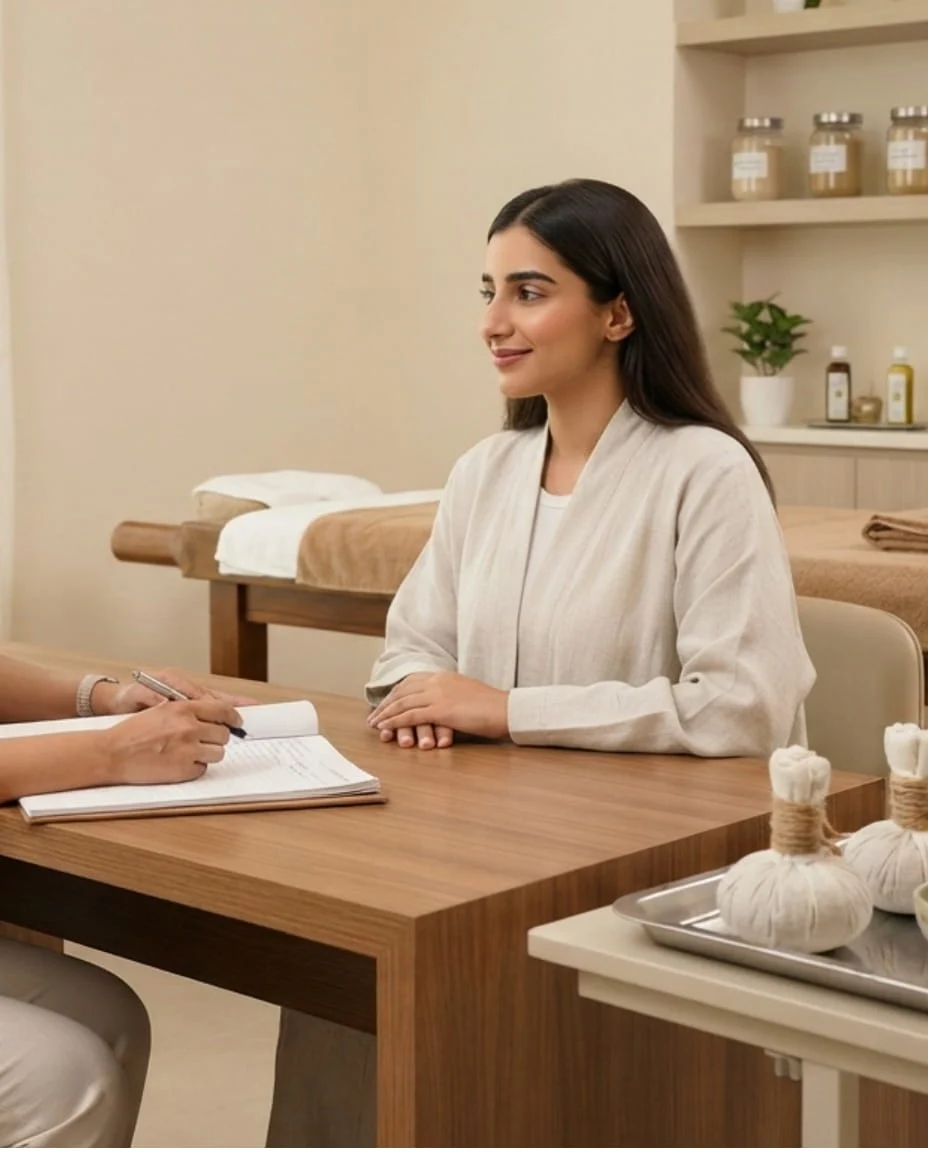
People who ask about Patra Pinda Sweda Therapy in JVC often include those exploring options, following practitioner assessment, for:
- ✓Muscle stiffness
- ✓Joint stiffness
- ✓Frozen shoulder
- ✓Selected back discomfort
- ✓Selected neck stiffness
- ✓Arthritis-related discomfort
- ✓General musculoskeletal tension
As with all the therapies described on this page, genuine suitability is determined through individual evaluation, not simply by matching one of the categories above.
IMPORTANT CONSIDERATIONS
Who May Not Be Suitable?
There are situations where Patra Pinda Sweda may need to be avoided, postponed, or modified, depending on individual clinical assessment. These can include:
- !Fever
- !Active infection
- !Open wounds
- !Active skin infection
- !Significant skin irritation
- !Reduced sensation to heat
- !Certain cardiovascular conditions
- !Acute injury
- !A severe inflammatory flare
- !Pregnancy or other special circumstances requiring individual assessment
This is not intended as a complete or exhaustive contraindication list — your practitioner will discuss anything specific to your situation during consultation.
Heat Safety
Because controlled warmth is central to this therapy, heat safety deserves its own dedicated discussion. Poorly managed temperature during any fomentation-based treatment carries certain risks, including:
Risk 1
Burns
Risk 2
Skin irritation
Risk 3
Excessive heat exposure
Risk 4
Dizziness
Risk 5
Dehydration
Controlled warmth is central to the Patra Pinda Sweda experience.
MEDICAL WARNING SIGNS
When Pain Needs Medical Attention
Please seek medical assessment, rather than Ayurvedic therapy, if you experience any of the following:
- !Sudden, severe pain
- !A major injury
- !New weakness
- !Numbness
- !Loss of bladder or bowel control
- !Fever accompanying joint or back pain
- !Significant swelling or redness
- !Unexplained weight loss
- !Severe pain that wakes you at night
- !Chest pain
- !Breathing difficulty
These symptoms call for prompt medical attention, and this page does not suggest Ayurvedic therapy as an appropriate first response to any of them.
CLASSICAL FRAMEWORK
Patra Pinda Sweda and Panchakarma
Swedana, the broader category of fomentation therapy that includes Patra Pinda Sweda, has a recognized role within classical Ayurvedic treatment. Patra Pinda Sweda may be incorporated into a broader Ayurvedic programme, including as part of a Panchakarma course in selected cases.
However, receiving Patra Pinda Sweda on its own does not automatically mean you are undergoing a complete Panchakarma programme — the two are related but distinct, and whether Patra Pinda Sweda is offered as a standalone therapy or as part of a wider Panchakarma plan depends on individual assessment. You can learn more about our broader Panchakarma in JVC service if this is something you’re considering.
TRADITIONAL CONCEPT
Patra Pinda Sweda and Dosha Assessment
Within the Ayurvedic framework, practitioners may consider a patient’s dosha constitution — commonly described using the three categories of Vata, Pitta, and Kapha — alongside their symptom pattern when planning treatment.
It’s important to be clear that dosha assessment belongs to the traditional Ayurvedic framework and should not be understood or presented as a modern medical diagnosis. It’s a lens Ayurvedic practitioners use to individualize care, not a replacement for clinical or laboratory-based diagnosis when that’s genuinely needed.
PRICING & INVESTMENT
Cost of Patra Pinda Sweda in Dubai
We recognize that Patra Pinda Sweda cost Dubai, Patra Pinda Sweda price Dubai, and Patra Pinda Sweda treatment cost JVC are common questions, and we won’t publish an invented figure here. Cost depends on several individual factors, including:
Please contact Vedara Care Polyclinic directly for current, accurate pricing.
LOCAL ACCESSIBILITY
Why Choose Patra Pinda Sweda in JVC?
Choosing where to receive Patra Pinda Sweda Therapy in JVC comes down to a few genuinely important factors:
- ✓A proper individual assessment before any treatment begins
- ✓A traditional Ayurvedic approach delivered by practitioners who understand the therapy’s classical foundations
- ✓Professional supervision throughout, particularly given the heat involved
- ✓The convenience of a JVC location for local patients
- ✓Clear patient education about what the therapy can and cannot be expected to do
- ✓A personalized treatment plan rather than a fixed, generic protocol
We haven’t used unsupported superlatives such as “best Patra Pinda Sweda clinic in Dubai” anywhere on this page, since that’s not a claim we can back up with legitimate evidence — we’d rather you judge this based on the substance of the information here.
CLINIC EXCELLENCE
Why Choose Vedara Care Polyclinic?
Vedara Care’s Ayurveda service in JVC includes Patra Pinda Sweda as part of its broader approach to selected conditions, including a frozen-shoulder programme that may combine Abhyanga, Patra Pinda Sweda, and internal Ayurvedic medicines depending on individual assessment. We’re not expanding this into a guaranteed protocol that applies to every frozen shoulder patient — what you receive depends on your specific evaluation. More broadly, choosing Vedara Care for this therapy means:
- ✓Access to a range of Ayurveda services, in case Patra Pinda Sweda isn’t the most appropriate fit for you
- ✓Individualized treatment planning based on genuine assessment
- ✓A convenient JVC location
- ✓Practitioner-led decision-making throughout your care
- ✓A multidisciplinary environment where relevant, allowing for referral to other services when appropriate
We haven’t included claims about success rates, patient numbers, awards, testimonials, or specific certifications on this page, since we’ve only included information that’s been verified for accuracy.
Frequently Asked Questions About Patra Pinda Sweda
Answers to common questions about Patra Pinda Sweda, suitability, herbal bolus formulation, protocol, aftercare, recovery and cost in JVC, Dubai.
Book ConsultationRELATED CONDITIONS AND TREATMENTS
Related Conditions and Treatments
Stiffness and pain can have many different underlying causes, and Patra Pinda Sweda Therapy in JVC is only one possible part of a broader, individualized Ayurvedic care plan. Because the right treatment depends heavily on what's actually causing your symptoms, we'd encourage a proper Ayurvedic consultation before assuming this particular therapy is the right fit.
If your concern is specifically knee-related, our Janu Basti Treatment in JVC page covers a different, knee-specific Ayurvedic therapy. For head, sinus, or neck-related concerns, our Nasya Therapy in JVC page may be more directly relevant. If you're interested in broader Ayurvedic oil massage, our Abhyanga in JVC page explains that therapy in more detail, and our Panchakarma in JVC page covers the wider classical Ayurvedic framework that Patra Pinda Sweda can sometimes form part of.
For musculoskeletal concerns with a stronger functional or rehabilitation component — such as building strength or restoring movement after injury — our Physiotherapy in JVC service may be a more directly relevant starting point, either instead of or alongside Ayurvedic therapy. You can also explore our full range of services on our Ayurveda Treatment in JVC page.
OUR LOCATION
Patra Pinda Sweda Therapy at Vedara Care Polyclinic
Vedara Care Polyclinic is located at Al Barsha South Fourth, Binghatti Azure, Shop -4, Jumeirah Village Circle (JVC), Dubai, UAE. Patients considering Patra Pinda Sweda Therapy in JVC begin with a consultation and individual assessment, so that any treatment plan reflects their specific musculoskeletal concern, medical history, and goals rather than a one-size-fits-all approach.
Vedara Care Polyclinic, Jumeirah Village Circle, Dubai.
LOCAL ACCESSIBILITY
Why Choose Patra Pinda Sweda Therapy in JVC?
Jumeirah Village Circle has grown into one of Dubai's most established residential communities, with a steady population of residents from neighbouring areas including Al Barsha South, Jumeirah Village Triangle, Dubai Sports City and Motor City who look locally for Ayurvedic therapy options rather than travelling across the city. For a traditional, session-based therapy like Patra Pinda Sweda — where a course of sessions rather than a single visit is often involved — having a clinic within the community makes it far more practical to stay consistent with a treatment plan.
A proper assessment helps confirm whether Patra Pinda Sweda is suitable for your musculoskeletal concern.
GET IN TOUCH
Book a Patra Pinda Sweda Therapy Consultation at Vedara Care Polyclinic
NEARBY LANDMARKS
- ✓Binghatti Azure building, Al Barsha South Fourth
- ✓Near JVC Circle roundabout, accessible from Hessa Street and Al Khail Road
DISTANCE FROM DUBAI COMMUNITIES
Important Information
Medical Disclaimer
The information provided on this page is for general educational purposes and does not replace individualized medical or Ayurvedic advice. Patra Pinda Sweda may not be appropriate for every patient or every type of pain, stiffness or musculoskeletal condition. A qualified healthcare professional should assess your symptoms and recommend an appropriate treatment plan.
READY TO START?
Explore Patra Pinda Sweda Therapy in JVC
If you’re considering Patra Pinda Sweda Therapy in JVC, the Ayurvedic team at Vedara Care Polyclinic — located at Al Barsha South Fourth, Binghatti Azure, Shop -4, Jumeirah Village Circle (JVC), Dubai, UAE — welcomes the opportunity to discuss your symptoms with you. During a consultation, we encourage you to talk through your symptoms, any previous injuries, current medications, existing medical conditions, and your treatment goals, so that together you can determine whether Patra Pinda Sweda — or another treatment approach — is genuinely appropriate for you. We don’t promise specific results, but we do commit to an honest, individualized assessment before recommending any treatment.
EXPLORE MORE
Related Ayurvedic Services in JVC
Ayurveda Clinic in JVC
Full range of traditional Ayurvedic therapies and consultations in JVC.
Learn moreAyurvedic Treatment in Dubai
Overview of Ayurvedic services offered by Vedara Care Polyclinic across Dubai.
Learn moreAbhyanga in Dubai
Traditional full-body Ayurvedic oil massage, sometimes combined with Patra Pinda Sweda within the same plan.
Learn moreJanu Basti Treatment in JVC
Localized Ayurvedic knee warm-oil retention therapy, often compared with Patra Pinda Sweda for knee concerns.
Learn moreNasya Therapy in JVC
Traditional Ayurvedic nasal therapy for head, sinus, and upper body health.
Learn morePanchakarma in JVC
Comprehensive Ayurvedic detoxification and rejuvenation procedures.
Learn morePhysiotherapy in JVC
Structured rehabilitation, strength, mobility and postural retraining services alongside Ayurvedic care.
Learn moreFrozen Shoulder Treatment
Specialized care and treatment options for frozen shoulder and mobility restrictions.
Learn moreBack Pain Treatment
Ayurvedic and physical rehabilitation approaches for chronic and acute back pain.
Learn moreSciatica Treatment
Targeted physiotherapy and care for nerve pain and sciatica relief.
Learn more