Hair loss is not one condition. The treatment that works for one type is wrong for another.
Authentic Ayurvedic treatment for hair loss in Dubai begins with identifying which clinical pattern you have — androgenetic, telogen effluvium, alopecia areata, postpartum, or scalp-condition driven. Each needs a different protocol. This page is written by the BAMS-qualified Ayurvedic physicians at our Jumeirah Village Circle (JVC) clinic, next to Circle Mall, and explains what real Ayurvedic hair loss treatment looks like in Dubai — including where the honest limits are.
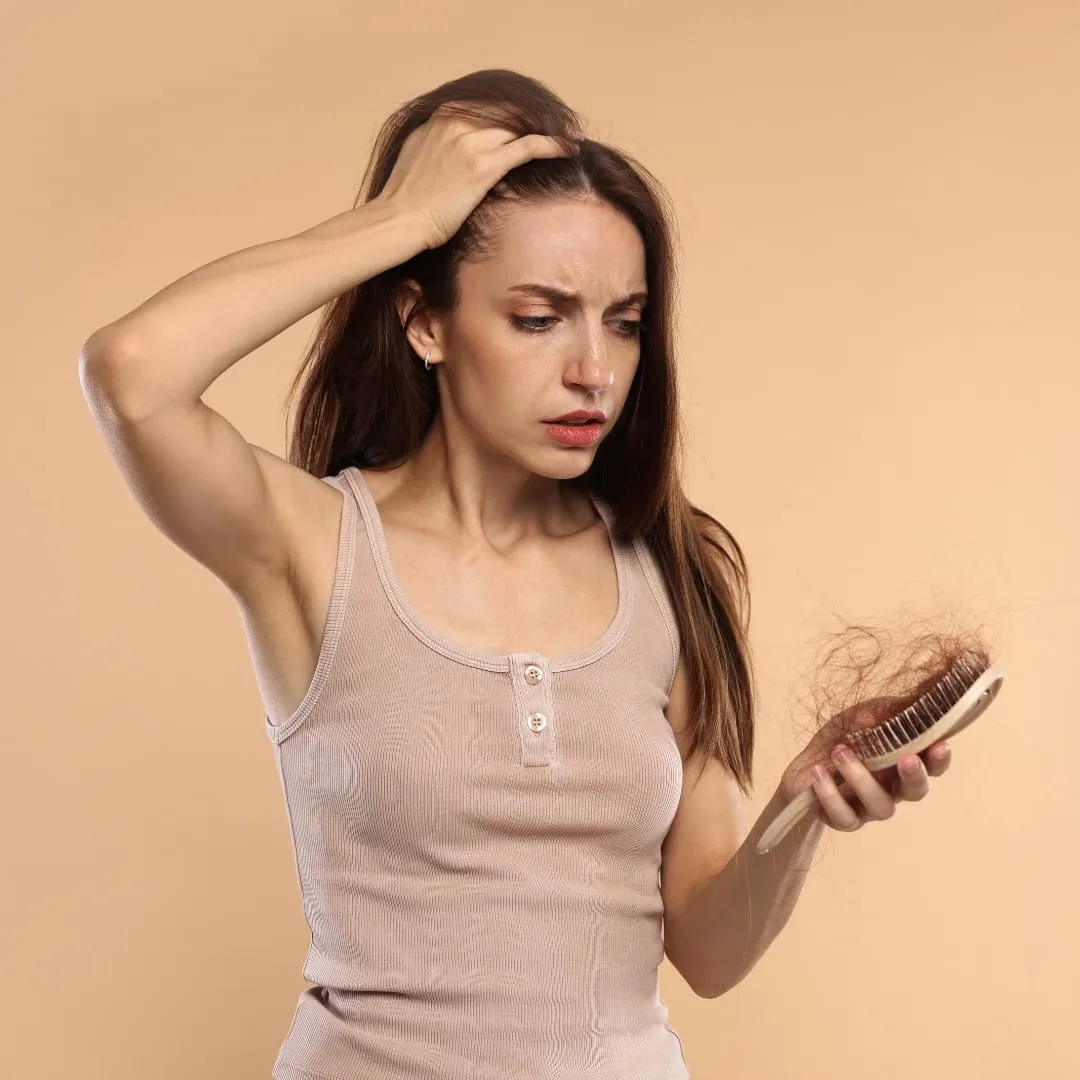
NO TRANSFORMATIONS. JUST EXAMINATION.
Hair loss assessment at our JVC clinic begins with scalp examination, hair pull test, and history. We do not show you results before we know the cause.
THE QUICK ANSWER
Ayurvedic hair loss treatment in Dubai, in one paragraph.
Ayurvedic treatment for hair loss in Dubai begins with identifying the specific clinical pattern — androgenetic alopecia, telogen effluvium, alopecia areata, postpartum hair loss, or scalp-condition-driven hair fall. Treatment typically combines Nasya (medicated nasal therapy, the classical Ayurvedic protocol for hair conditions), specific scalp therapies including Abhyanga (Shiroabhyanga) and Shirodhara, internal herbal medicines selected for your dosha pattern, dietary regulation addressing root causes, and where indicated, integration with dermatology. At Vedara Care Polyclinic in Jumeirah Village Circle (JVC), Dubai — next to Circle Mall — programmes typically run 3 to 9 months depending on the type and severity. Initial consultations start from AED 350.
Medically reviewed by Dr. [Lead Ayurvedic Physician], BAMS, MD (Ayurveda), DHA-Licensed 2509266 · Last updated May 2026
PATTERN MATTERS
Five clinical patterns of hair loss. Yours is one of them.
Each pattern has different causes, different treatment priorities, and different realistic expectations. Identifying which pattern you have is the first step at our JVC clinic — and where most generic hair loss treatments go wrong.
A
Androgenetic Alopecia (Male and Female Pattern)
Khalatiya in classical Sanskrit
The most common hair loss pattern globally. In men, presents as receding hairline and crown thinning, usually progressive from late 20s onwards. In women, presents as diffuse thinning across the crown, often noticed in 30s and 40s. Strongly genetic, hormone-mediated (androgens), and often family-clustered. Particularly common in South Asian and Middle Eastern men in Dubai.
Ayurvedic emphasis for this phenotype:
Nasya, Shirodhara, internal Bhringraja-based protocols, 6-9 month programme alongside dermatology where indicated
B
Telogen Effluvium (Diffuse Shedding)
Indralupta-adjacent in classical texts
Sudden, diffuse hair shedding 2-4 months after a triggering event — childbirth, severe illness (including COVID), surgery, significant weight loss, severe telogen effluvium from stress, iron deficiency, or medication changes. Hair falls from all over the scalp rather than in specific patterns. Most common in women aged 25-45. Usually reversible if root cause is addressed.
Ayurvedic emphasis for this phenotype:
Trigger identification, internal Rasayana medicines, dietary correction, 3-6 month recovery programme
C
Alopecia Areata
Indralupta in classical Sanskrit
Sudden patchy hair loss in well-defined circular or oval patches on the scalp (or sometimes beard, eyebrows, body). Autoimmune in origin. Onset can be at any age. Can resolve spontaneously, persist, or progress. Most clinically complex pattern to treat and most variable in outcomes.
Ayurvedic emphasis for this phenotype:
Local therapies (medicated oil applications, Raktamokshana in specific cases), internal immune-modulating medicines, dermatology coordination
D
Postpartum Hair Loss
Often classified under Sutika Vikara in classical Sanskrit
Significant hair shedding 2-6 months after childbirth, peaking around month 3-4. Hormonally driven — the hair that should have shed during pregnancy releases all at once postpartum. Common (affecting roughly 50% of new mothers) and almost always self-resolving by 12-18 months — but the experience is distressing and Ayurvedic support can meaningfully reduce severity and shorten recovery.
Ayurvedic emphasis for this phenotype:
Classical Sutika Paricharya 45-day postnatal programme, Bhringraja-based oils, internal medicines for postnatal Vata pacification, nutritional restoration
E
Scalp-Condition-Driven Hair Loss
Multiple Sanskrit classifications including Darunaka and Palitya-related
Hair loss secondary to scalp conditions — seborrheic dermatitis, scalp psoriasis, fungal infections, severe dandruff, scarring scalp conditions. The scalp needs treatment before the hair can grow back. Different protocol from other patterns — primary focus is restoring scalp health.
Ayurvedic emphasis for this phenotype:
Scalp-specific medicated oil treatments, internal medicines for the underlying skin condition, dermatology coordination for diagnosis confirmation
Most patients arrive at our JVC clinic not knowing which pattern they have. Some patients have more than one pattern simultaneously — particularly women with androgenetic alopecia experiencing postpartum exacerbation, or men with both androgenetic and stress-driven shedding. Pattern identification at consultation is the foundation of an effective treatment plan.
Authentic Ayurvedic hair loss treatment works on four levels simultaneously.
In classical Ayurveda, hair (Kesha) is considered a tissue (upadhatu) of bone tissue (asthi dhatu) — meaning hair health is genuinely connected to deeper metabolic and constitutional patterns, not just to the scalp itself. This is why treating hair loss with topical oils alone, however expensive, produces only partial results.
Authentic treatment at our JVC clinic works on four parallel levels. Local scalp therapy addresses the scalp environment directly — through specific medicated oil applications, Abhyanga (Shiroabhyanga, head massage), Shirodhara, and where indicated, Takradhara (buttermilk-based variant especially useful for inflammatory scalp conditions). Nasya therapy — medicated oils administered through the nasal passages — is the classical Ayurvedic protocol specifically for hair, considered in the texts to be the most direct route to nourish the structures of the head. Internal medicines address the systemic patterns underlying your specific type of hair loss — different formulations for androgenetic vs telogen vs autoimmune patterns. Lifestyle and dietary regulation addresses the root patterns that perpetuate hair loss — stress, sleep quality, iron and protein adequacy, hormonal balance, scalp hygiene, and the specific Dubai-life factors that affect hair (sun exposure, hard water, air conditioning, hair-care chemical load).
The honest position is this: Ayurvedic hair loss treatment works substantially when all four levels are addressed for 3–9 months depending on pattern. It works marginally when only topical oils or only internal medicines are used. This is why treatment requires consultation and commitment, not products.
"Hair grows from the scalp, but the scalp is fed by the body. Treating the scalp without treating the body addresses the surface, not the cause."
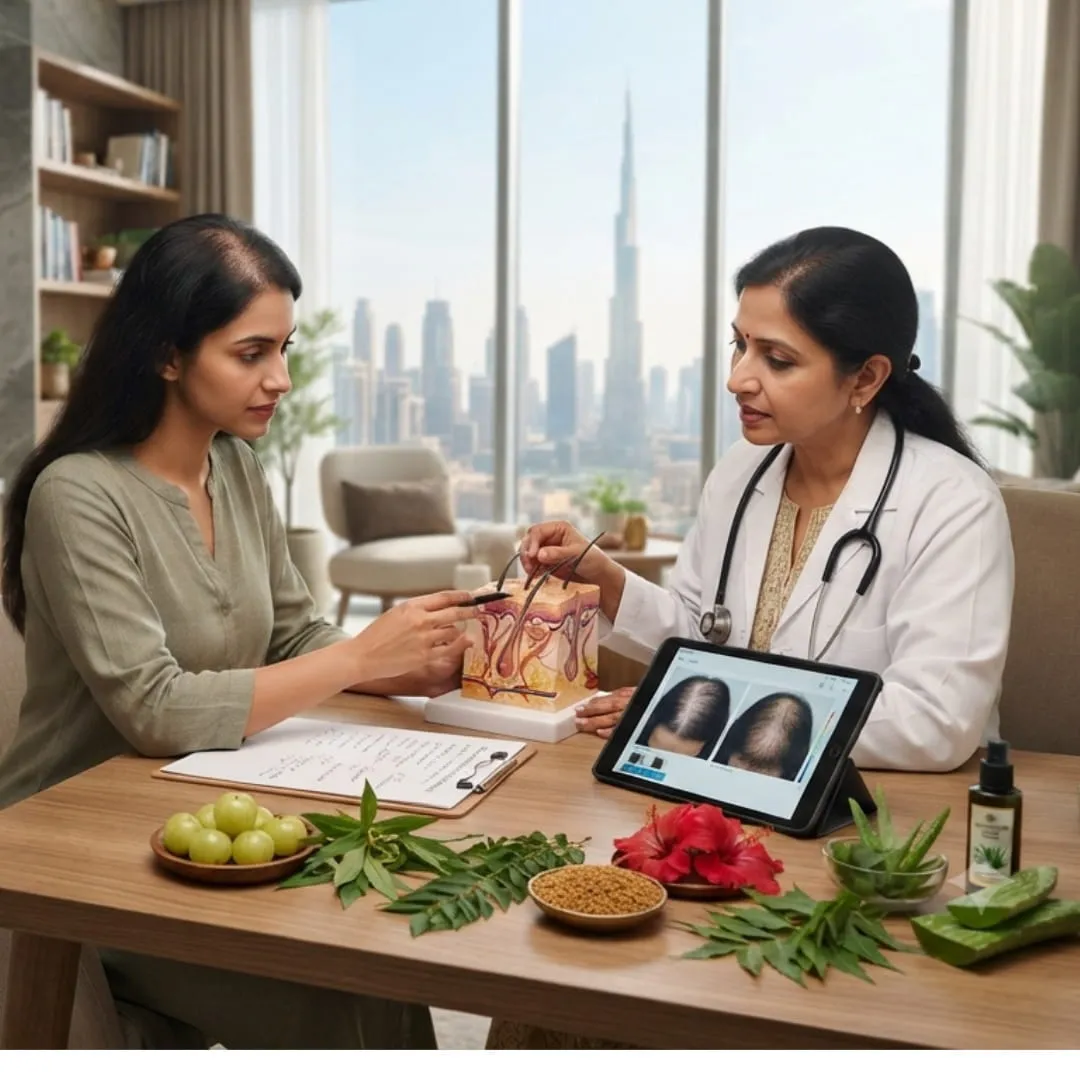
The therapies used in Ayurvedic hair loss protocols at our JVC clinic.
Different therapies serve different roles in the protocol. Not every patient receives every therapy — your doctor selects based on your specific pattern.
Nasya
The classical hair therapy
Medicated oils administered through the nasal passages — considered in Ayurvedic texts the most direct route to nourish the head and hair structures. Typically performed as 7–14 day intensive courses, often repeated 2–3 times during a 6–9 month programme. Different oils for different patterns — Anu Taila for androgenetic, Shadbindu Taila for inflammatory scalp conditions.
Shirodhara
For stress-driven and hormonal hair loss
The continuous warm medicated oil stream therapy. For hair loss specifically, often used in patients with telogen effluvium from stress, postpartum hair loss with mood involvement, and androgenetic alopecia with significant stress component. Calms the autonomic nervous system, reduces cortisol, and supports overall recovery.
Read about Shirodhara → →Takradhara
The variant for inflammatory scalp conditions
A specific Shirodhara variant using fermented buttermilk instead of oil — particularly effective for hair loss driven by scalp inflammation, psoriasis, severe dandruff, and certain hormone-mediated patterns. Less commonly used than oil Shirodhara but highly specific in its indications.
Shiroabhyanga and Scalp Therapies
Direct scalp treatment
Daily or weekly head massage with medicated oils — typically Bhringraja Taila, Neelibhringadi Taila, or other classical preparations selected for your pattern. Done both at the clinic during the intensive phase and as home protocol throughout the programme. Improves scalp circulation, nourishes follicles, and addresses the local scalp environment.
Internal Medicines & Panchakarma
The systemic foundation
For severe or long-standing hair loss, classical Panchakarma over 7–14 days addresses systemic root patterns. Internal herbal medicines — typically including Bhringraja, Amalaki, Brahmi, Neelibhringadi tablets, and pattern-specific formulations — are prescribed throughout the programme. Sourced from classical Ayurvedic pharmacies in Kerala with documented quality.
Read about Internal Medicines & Panchakarma → →What six months of Ayurvedic hair loss treatment at our JVC clinic actually looks like.
A representative protocol for moderate hair loss. Severe androgenetic patterns may need 9 months; mild telogen effluvium may resolve in 3-4 months. Your plan is calibrated to your pattern.
Assessment & Foundation
- •60-minute consultation with BAMS-qualified Ayurvedic physician at our Ayurveda Clinic in JVC
- •Comprehensive scalp examination, hair pull test, hair density assessment
- •Review of any existing diagnoses, blood work, dermatology reports
- •Pattern identification (which of the five clinical types)
- •Pulse diagnosis and dosha assessment
- •Iron studies, thyroid panel, hormone assessment (if not recent)
- •Initial herbal medicine protocol begins
- •Home scalp oil protocol introduced
Expected by end of Month 1: clear pattern diagnosis, baseline hair count established, lab results reviewed, treatment plan signed off
Intensive Nasya & Scalp Therapy
- •First 7-day Nasya course (typically days 1-7 of month)
- •2-3 Abhyanga (Shiroabhyanga) sessions per week through the month
- •Continued internal medicines
- •Dietary protocol fully implemented
- •For inflammatory patterns: Takradhara sessions added
Expected by end of Month 2: noticeable reduction in daily shedding (telogen patterns), early signs of improved scalp environment, possible early sensation of new growth at hairline
Continued Active Treatment
- •Mid-programme doctor review with hair density reassessment
- •Refined herbal medicine protocol
- •Continuation of weekly Abhyanga (Shiroabhyanga)
- •Possible introduction of Shirodhara if stress factors significant
- •Lifestyle protocols fully established
Expected by end of Month 3: shedding typically significantly reduced for telogen patterns, hairline beginning to show early stabilisation for androgenetic patterns, scalp condition substantially improved for inflammatory patterns
Second Nasya Cycle & Consolidation
- •Second 7-day Nasya course (typically days 1-7 of month)
- •Continued scalp therapies
- •Internal medicines maintained
- •For complex patterns: Panchakarma considered if indicated
- •Mid-cycle doctor review
Expected by end of Month 4: new hair growth typically visible at hairline (1-2 cm length), reduced visible scalp at part-line for women with diffuse thinning
Refinement
- •Personalised maintenance dose of herbal medicines
- •Reduced clinical visits (typically every 2 weeks)
- •Home protocol becoming established habit
- •Hair density photographs for comparison with baseline
- •Long-term plan discussion
Expected by end of Month 5: visible improvement in hair density at crown and hairline, return to washing frequency that supports rather than damages hair, normalised shedding pattern.
Discharge & Maintenance
- •Final assessment with photographic comparison
- •Transition to maintenance protocol
- •3-month home herbal course
- •Continued home Shiroabhyanga twice weekly
- •3-month and 6-month follow-up appointments
- •Annual return considered for ongoing maintenance
Expected by end of Month 6: substantial visible improvement for telogen and inflammatory patterns, meaningful stabilisation and partial regrowth for androgenetic patterns, clear home maintenance plan to sustain results
This is a representative 6-month protocol. Severe androgenetic patterns often need 9-12 months. Alopecia areata is highly variable. Postpartum hair loss often resolves in 3-4 months with structured treatment. Your timeline is documented and updated at each monthly review at our JVC clinic.
REALISTIC EXPECTATIONS
What outcomes are realistic — for your specific pattern.
Different hair loss patterns respond at different rates and to different degrees. Realistic expectations prevent the disappointment that drives patients to hair transplants prematurely.
Androgenetic Alopecia
The most realistic outcome is stabilisation plus partial regrowth. Ayurvedic treatment for androgenetic alopecia at our JVC clinic typically slows or arrests progression for 6-12 months, partially regrows recently-lost hair (within the last 12-18 months), and improves overall hair quality and density. Hair lost more than 2-3 years ago does not regrow with Ayurveda alone — for that, dermatology integration (minoxidil, finasteride, or in select cases, transplant) may be appropriate.
Telogen Effluvium
The most responsive pattern. With proper Ayurvedic treatment, postpartum and post-illness telogen effluvium typically resolves in 4-6 months — often with full hair density restoration. Treatment focuses on addressing the underlying trigger (iron deficiency, hormonal recovery, nutritional restoration) while supporting the scalp environment.
Alopecia Areata
The most variable pattern. Some patients see full patch regrowth within 3-6 months of starting treatment. Others see partial regrowth. A minority show limited response. Ayurvedic treatment is most effective in early, limited alopecia areata; less effective in extensive or long-standing cases. Always coordinated with dermatology.
Postpartum Hair Loss
The most predictable pattern. Postpartum hair shedding almost always resolves spontaneously by 12-18 months. Ayurvedic treatment — particularly the classical 45-day Sutika Paricharya protocol — typically reduces severity and shortens recovery to 6-9 months, with better hair quality at the end. Common in women across JVC, JVT, and Dubai expat populations.
Scalp-Condition-Driven Hair Loss
Resolves to the degree the underlying scalp condition can be controlled. For seborrheic dermatitis and severe dandruff, treatment is often substantial and hair regrowth follows. For scalp psoriasis, ongoing management. For scarring scalp conditions, lost hair does not regrow but progression can be arrested.
We will not promise miraculous regrowth at consultation, because such promises are how patients waste years of their hair loss on wrong treatments. We will tell you honestly what is achievable for your specific pattern, in what timeframe, with what realistic adherence to the protocol.
Why most "Ayurvedic hair loss treatment" in Dubai fails — and what we do differently.
Patients arrive at our JVC clinic having tried multiple "Ayurvedic" hair products. Branded oils from supermarkets, mass-market hair-growth serums, generic Bhringraja oils ordered online, supplement combinations promoted by influencers. Almost none work meaningfully — and the patients are typically angry at "Ayurveda" by the time they walk in. The frustration is understandable. The diagnosis is wrong.
What patients have tried is product Ayurveda — single ingredients applied generically without consultation, without pattern identification, and without addressing internal medicines, dietary patterns, or the four-level treatment approach authentic Ayurveda requires. Product Ayurveda for hair loss is to clinical Ayurveda what taking a multivitamin is to seeing an endocrinologist. The ingredients may be similar. The clinical outcomes are not.
What works is a structured 3-9 month programme at a DHA-licensed clinic — pattern identification, Nasya, scalp therapies, internal medicines selected for your specific pattern, dietary correction, and addressing root patterns. This is not what you can buy at Carrefour or Amazon. It is what authentic Ayurvedic hair loss treatment has always required — and what most Dubai "Ayurvedic hair care" markets without delivering.
"If your hair loss treatment came with a sales tag and not a consultation, it is not really Ayurveda. It is a product wearing Ayurveda as marketing."
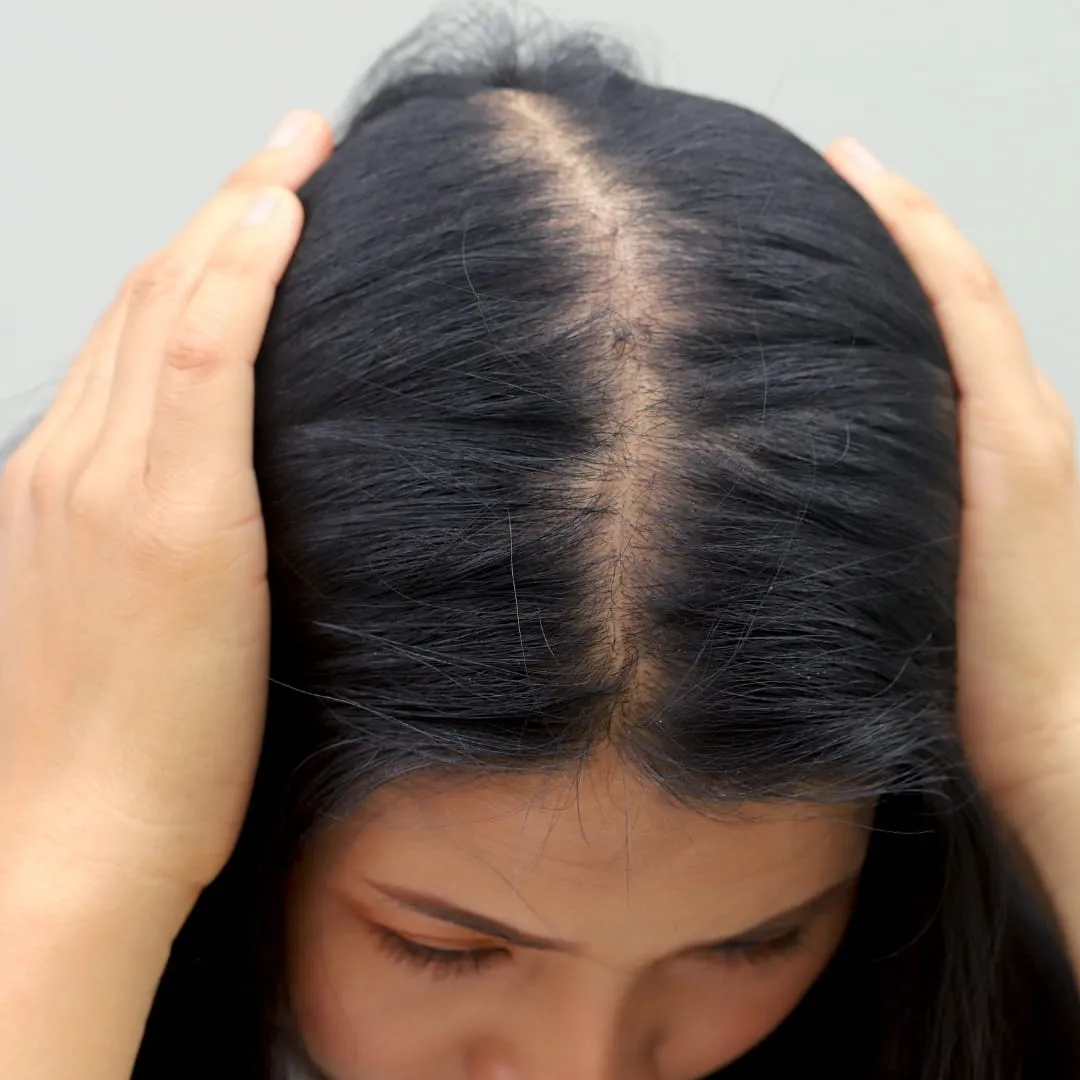
HONEST CLINICAL BOUNDARIES
When we refer you elsewhere first.
Ayurvedic hair loss treatment is powerful for specific patterns. It is not appropriate as the primary treatment for certain conditions.
GET EVALUATED FIRST
- Sudden patchy hair loss appearing in the last 4 weeks (rule out alopecia areata progression vs trichotillomania)
- Hair loss with skin rash, scalp pain, or scarring (needs dermatology to confirm scarring vs non-scarring alopecia)
- Hair loss with significant fatigue, weight changes, or temperature intolerance (thyroid evaluation needed)
- Hair loss with iron-deficiency symptoms (iron studies and underlying cause needed)
- Hair loss starting after specific medication (medication review needed first)
- Hair loss with autoimmune symptoms elsewhere (rheumatology may be appropriate)
BEST USED COMBINED
- Severe androgenetic alopecia where minoxidil or finasteride is already part of the plan
- Alopecia areata of moderate or greater severity (dermatologist often leads, Ayurveda supports)
- Scalp psoriasis with hair fall (dermatology for psoriasis, Ayurveda for hair)
- Patients considering hair transplant (Ayurvedic preparation often improves transplant outcomes)
- Post-chemotherapy hair regrowth (Ayurvedic support alongside oncology recovery)
Real Ayurvedic doctors at our JVC clinic refer to dermatology, endocrinology, or other specialists when needed — and coordinate care rather than compete with it. For Dubai hair loss patients, the strongest outcomes often come from combined Ayurveda + dermatology programmes.
Real hair loss outcomes from our JVC clinic
"undefined"
Sarah K.
Age 32, Dubai Marina · Postpartum hair loss · 4-month programme
"undefined"
Fatima A.
Age 38, Jumeirah Village Circle · Telogen effluvium · 6-month programme
"undefined"
Ahmed S.
Age 42, Business Bay · Androgenetic alopecia · 9-month programme + maintenance
4.9
Stars on Google
86%
reported visible improvement at 6 months
78%
Hair loss reviews
What Ayurvedic hair loss treatment in Dubai actually costs.
Indicative pricing for our three most-common hair loss programmes. Final pricing depends on pattern, severity, and protocol intensity confirmed at consultation.
Hair Loss Initial Assessment
- Comprehensive consultation with BAMS-qualified physician
- Scalp examination, hair pull test, density assessment
- Pattern identification (which of the five types)
- Review of existing reports and medications
- Pulse diagnosis and dosha assessment
- Lab orders if needed (iron, thyroid, hormones)
- Written treatment plan
- Full programme pricing in writing
First step for every hair loss patient — required before any treatment programme
Standard 6-Month Hair Loss Programme
- All Initial Assessment components
- 2 intensive Nasya courses (months 2 and 4)
- Weekly Abhyanga (Shiroabhyanga) during months 1-3
- Monthly Shirodhara where indicated (months 2-5)
- 6 months of internal Ayurvedic medicines
- Home scalp oil protocol with medicated oils
- Monthly doctor reviews
- 3-month and 6-month follow-up after programme
Standard treatment for telogen effluvium, moderate androgenetic alopecia, and most hair loss patterns
Comprehensive Hair Loss + Dermatology Programme
- All Standard Programme components
- Joint Ayurvedic + dermatology consultation (when dermatology launches)
- Coordinated treatment with topical agents where appropriate
- Extended Panchakarma component (7-14 days, typically month 3-4)
- Photographic monitoring with baseline, 3-month, 6-month documentation
- Annual maintenance returns recommended
Severe androgenetic alopecia, complex alopecia areata, scalp-condition-driven hair loss, patients wanting maximum integrated outcomes
Insurance direct-billing available with seven major insurers — coverage for Ayurvedic dermatological care varies by plan. WhatsApp us your card before booking to confirm coverage.
What patients ask before starting Ayurvedic hair loss treatment.
For specific treatment details, see the Nasya, Shirodhara, and Panchakarma pages. For PCOS-related hair loss, see our PCOS condition page.
Ask the Hair Loss TeamWHERE WE TREAT
Our hair loss clinic in Jumeirah Village Circle (JVC), Dubai.
NEARBY LANDMARKS
- ✓Walking distance from Circle Mall, JVC
DISTANCE FROM DUBAI COMMUNITIES
READY?
Start with the right diagnosis. The treatment follows from there.
Hair loss is one of the most over-treated and under-diagnosed conditions in Dubai. Generic products, generic recommendations, and generic clinics produce generic results. A proper 60-minute consultation at our JVC clinic — scalp examination, pattern identification, written treatment plan — costs AED 350 and is the difference between months of wasted treatment and a structured programme that actually delivers.
Initial consultation from AED 350 · Walking distance from Circle Mall, JVC · Female doctors available · Insurance direct-billing · Free clinic parking
EXPLORE FURTHER
Related pages.
Shirodhara in Dubai
The continuous warm oil therapy frequently used in hair loss protocols, particularly for stress-driven and hormonal patterns.
Learn moreAyurveda for PCOS in Dubai
For women whose hair loss is part of PCOS — the underlying hormonal pattern needs addressing alongside the hair-specific protocol.
Learn morePanchakarma in Dubai
For severe or long-standing hair loss, classical Panchakarma addresses the systemic root patterns. 7, 14, and 21-day programmes.
Learn moreOur Ayurveda Clinic in JVC
The full picture of our Ayurveda department, doctors, treatments, and other conditions we treat at our JVC clinic.
Learn more